
 |
P r o p h e t i e s O n L i n e |


 |
The largest library about Nostradamus for free ! |

 |
Don Giovanni Bosco Altre Profezie Elisabetta Canori Catherine Emmerich Suor Gabriella Gioachino da Fiore Jacob Lorber Saint Malachia Rasputin Suor Ali' Anna Maria Taigi The Archangels Maria Valtorta The Virgin of Naju
|
By clicking from the top links you can access pages relating to some very famous mystics |
|
|
|
|
|
Read my blog below, or check it online at: |
|
|
Note: All reasonable
attempts have been made to contact the copyright We would be grateful if any whom we have been unable to contact would get in touch with us.
|
|
|
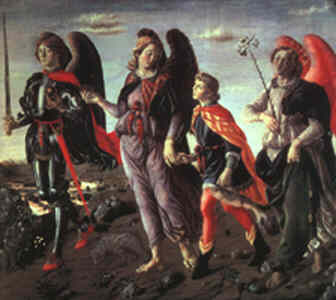
St. Michael the Archangel
(Hebrew "Who is like God?").
St. Michael is one of the principal angels; his name was the war-cry of the good angels in the battle fought in heaven against the enemy and his followers. Four times his name is recorded in Scripture: (1) Daniel 10:13 sqq., Gabriel says to Daniel, when he asks God to permit the Jews to return to Jerusalem: "The Angel [D.V. prince] of the kingdom of the Persians resisted me . . . and, behold Michael, one of the chief princes, came to help me . . . and none is my helper in all these things, but Michael your prince"; (2) Daniel 12, the Angel speaking of the end of the world and the Antichrist says: "At that time shall Michael rise up, the great prince, who standeth for the children of thy people." (3) In the Catholic Epistle of St. Jude: "When Michael the Archangel, disputing with the devil, contended about the body of Moses", etc. St. Jude alludes to an ancient Jewish tradition of a dispute between Michael and Satan over the body of Moses, an account of which is also found in the apocryphal book on the assumption of Moses (Origen, "De principiis", III, 2, 2). St. Michael concealed the tomb of Moses; Satan, however, by disclosing it, tried to seduce the Jewish people to the sin of hero-worship. St. Michael also guards the body of Eve, according to the "Revelation of Moses" ("Apocryphal Gospels", etc., ed. A. Walker, Edinburgh, p. 647). (4) Apocalypse 12:7, "And there was a great battle in heaven, Michael and his angels fought with the dragon." St. John speaks of the great conflict at the end of time, which reflects also the battle in heaven at the beginning of time. According to the Fathers there is often question of St. Michael in Scripture where his name is not mentioned. They say he was the cherub who stood at the gate of paradise, "to keep the way of the tree of life" (Gen., iii, 24), the angel through whom God published the Decalogue to his chosen people, the angel who stood in the way against Balaam (Numbers 22:22 sqq.), the angel who routed the army of Sennacherib (IV Kings 19:35). Following these Scriptural passages, Christian tradition gives to St. Michael four offices:
Regarding his rank in the celestial hierarchy opinions vary; St. Basil (Hom. de angelis) and other Greek Fathers, also Salmeron, Bellarmine, etc., place St. Michael over all the angels; they say he is called "archangel" because he is the prince of the other angels; others (cf. P. Bonaventura, op. cit.) believe that he is the prince of the seraphim, the first of the nine angelic orders. But, according to St. Thomas (Summa, I:113:3) he is the prince of the last and lowest choir, the angels. The Roman Liturgy seems to follow the Greek Fathers; it calls him "Princeps militiae coelestis quem honorificant angelorum cives". The hymn of the Mozarabic Breviary places St. Michael even above the Twenty-four Elders. The Greek Liturgy styles him Archistrategos, "highest general" (cf. Menaea, 8 Nov. and 6 Sept.). VENERATION It would have been natural to St. Michael, the champion of the Jewish people, to be the champion also of Christians, giving victory in war to his clients. The early Christians, however, regarded some of the martyrs as their military patrons: St. George, St. Theodore, St. Demetrius, St. Sergius, St. Procopius, St. Mercurius, etc.; but to St. Michael they gave the care of their sick. At the place where he was first venerated, in Phrygia, his prestige as angelic healer obscured his interposition in military affairs. It was from early times the centre of the true cult of the holy angels, particularly of St. Michael. Tradition relates that St. Michael in the earliest ages caused a medicinal spring to spout at Chairotopa near Colossae, where all the sick who bathed there, invoking the Blessed Trinity and St. Michael, were cured. Still more famous are the springs which St. Michael is said to have drawn from the rock at Colossae (Chonae, the present Khonas, on the Lycus). The pagans directed a stream against the sanctuary of St. Michael to destroy it, but the archangel split the rock by lightning to give a new bed to the stream, and sanctified forever the waters which came from the gorge. The Greeks claim that this apparition took place about the middle of the first century and celebrate a feast in commemoration of it on 6 September (Analecta Bolland., VIII, 285-328). Also at Pythia in Bithynia and elsewhere in Asia the hot springs were dedicated to St. Michael. At Constantinople likewise, St. Michael was the great heavenly physician. His principal sanctuary, the Michaelion, was at Sosthenion, some fifty miles south of Constantinople; there the archangel is said to have appeared to the Emperor Constantine. The sick slept in this church at night to wait for a manifestation of St. Michael; his feast was kept there 9 June. Another famous church was within the walls of the city, at the thermal baths of the Emperor Arcadius; there the synaxis of the archangel was celebrated 8 November. This feast spread over the entire Greek Church, and the Syrian, Armenian, and Coptic Churches adopted it also; it is now the principal feast of St. Michael in the Orient. It may have originated in Phrygia, but its station at Constantinople was the Thermae of Arcadius (Martinow, "Annus Graeco-slavicus", 8 Nov.). Other feasts of St. Michael at Constantinople were: 27 October, in the "Promotu" church; 18 June, in the Church of St. Julian at the Forum; and 10 December, at Athaea. The Christians of Egypt placed their life-giving river, the Nile under the protection of St. Michael; they adopted the Greek feast and kept it 12 November; on the twelfth of every month they celebrate a special commemoration of the archangel, but 12 June, when the river commences to rise, they keep as a holiday of obligation the feast of St. Michael "for the rising of the Nile", euche eis ten symmetron anabasin ton potamion hydaton. At Rome the Leonine Sacramentary (sixth century) has the "Natale Basilicae Angeli via Salaria", 30 September; of the five Masses for the feast three mention St. Michael. The Gelasian Sacramentary (seventh century) gives the feast "S. Michaelis Archangeli", and the Gregorian Sacramentary (eighth century), "Dedicatio Basilionis S. Angeli Michaelis", 29 Sept. A manuscript also here adds "via Salaria" (Ebner, "Miss. Rom. Iter Italicum", 127). This church of the Via Salaria was six miles to the north of the city; in the ninth century it was called Basilica Archangeli in Septimo (Armellini, "Chiese di Roma", p. 85). It disappeared a thousand years ago. At Rome also the part of heavenly physician was given to St. Michael. According to an (apocryphal?) legend of the tenth century he appeared over the Moles Hadriani (Castel di S. Angelo), in 950, during the procession which St. Gregory held against the pestilence, putting an end to the plague. Boniface IV (608-15) built on the Moles Hadriani in honour of him, a church, which was styled St. Michaelis inter nubes (in summitate circi). Well known is the apparition of St. Michael (a. 494 or 530-40), as related in the Roman Breviary, 8 May, at his renowned sanctuary on Monte Gargano, where his original glory as patron in war was restored to him. To his intercession the Lombards of Sipontum (Manfredonia) attributed their victory over the Greek Neapolitans, 8 May, 663. In commemoration of this victory the church of Sipontum instituted a special feast in honour of the archangel, on 8 May, which has spread over the entire Latin Church and is now called (since the time of Pius V) "Apparitio S. Michaelis", although it originally did not commemorate the apparition, but the victory. In Normandy St. Michael is the patron of mariners in his famous sanctuary at Mont-Saint-Michel in the diocese of Coutances. He is said to have appeared there, in 708, to St. Aubert, Bishop of Avranches. In Normandy his feast "S. Michaelis in periculo maris" or "in Monte Tumba" was universally celebrated on 18 Oct., the anniversary of the dedication of the first church, 16 Oct., 710; the feast is now confined to the Diocese of Coutances. In Germany, after its evangelization, St. Michael replaced for the Christians the pagan god Wotan, to whom many mountains were sacred, hence the numerous mountain chapels of St. Michael all over Germany. The hymns of the Roman Office are said to have been composed by St. Rabanus Maurus of Fulda (d. 856). In art St. Michael is represented as an angelic warrior, fully armed with helmet, sword, and shield (often the shield bears the Latin inscription: Quis ut Deus), standing over the dragon, whom he sometimes pierces with a lance. He also holds a pair of scales in which he weighs the souls of the departed (cf. Rock, "The Church of Our Fathers", III, 160), or the book of life, to show that he takes part in the judgment. His feast (29 September) in the Middle Ages was celebrated as a holy day of obligation, but along with several other feasts it was gradually abolished since the eighteenth century (see FEASTS). Michaelmas Day, in England and other countries, is one of the regular quarter-days for settling rents and accounts; but it is no longer remarkable for the hospitality with which it was formerly celebrated. Stubble-geese being esteemed in perfection about this time, most families had one dressed on Michaelmas Day. In some parishes (Isle of Skye) they had a procession on this day and baked a cake, called St. Michael's bannock. FREDERICK G. HOLWECK From the Catholic Encyclopedia, copyright © 1913 by the Encyclopedia Press, Inc. Electronic version copyright © 1996 by New Advent, Inc.
St. Gabriel the Archangel"Fortitudo Dei", one of the three archangels mentioned in the Bible. Only four appearances of Gabriel are recorded:
Thus he is throughout the angel of the Incarnation and of Consolation, and so in Christian tradition Gabriel is ever the angel of mercy while Michael is rather the angel of judgment. At the same time, even in the Bible, Gabriel is, in accordance with his name, the angel of the Power of God, and it is worth while noting the frequency with which such words as "great", "might", "power", and "strength" occur in the passages referred to above. The Jews indeed seem to have dwelt particularly upon this feature in Gabriel's character, and he is regarded by them as the angel of judgment, while Michael is called the angel of mercy. Thus they attribute to Gabriel the destruction of Sodom and of the host of Sennacherib, though they also regard him as the angel who buried Moses, and as the man deputed to mark the figure Tau on the foreheads of the elect (Ezech., 4). In later Jewish literature the names of angels were considered to have a peculiar efficacy, and the British Museum possesses some magic bowls inscribed with Hebrew, Aramaic, and Syriac incantations in which the names of Michael, Raphael, and Gabriel occur. These bowls were found at Hillah, the site of Babylon, and constitute an interesting relic of the Jewish captivity. In apocryphal Christian literature the same names occur, cf. Enoch, ix, and the Apocalypse of the Blessed Virgin. As remarked above, Gabriel is mentioned only twice in the New Testament, but it is not unreasonable to suppose with Christian tradition that it is he who appeared to St. Joseph and to the shepherds, and also that it was he who "strengthened" Our Lord in the garden (cf. the Hymn for Lauds on 24 March). Gabriel is generally termed only an archangel, but the expression used by St. Raphael, "I am the angel Raphael, one of the seven, who stand before the Lord" (Tob., xii, 15) and St. Gabriel's own words, "I am Gabriel, who stand before God" (Luke 1, 19), have led some to think that these angels must belong to the highest rank; but this is generally explained as referring to their rank as the highest of God's messengers, and not as placing them among the Seraphim and Cherubim (cf. St. Thomas, I, Q. cxii, a.3; III, Q. xxx, a.2, ad 4um). In addition to the literature under ANGEL and in the biblical dictionaries, see PUSEY, The Prophet Daniel (London, 1868); EDERSHEIM, Jesus the Messiah (London and New York, 1890), Append. XIII; H. CROSBY, Michael and Gabriel in Homiletic Review (1890), XIX, 160-162; BARDENHEWER, Mariä-Verkündigung in Bibl. Studien, X, 496 sqq. HUGH POPE From the Catholic
Encyclopedia, copyright © 1913 by the Encyclopedia Press, Inc.
Electronic version copyright © 1996 by
New Advent, Inc.
St. RaphaelThe name of this archangel (Raphael = "God has healed") does not appear in the Hebrew Scriptures, and in the Septuagint only in the Book of Tobias. Here he first appears disguised in human form as the travelling companion of the younger Tobias, calling himself "Azarias the son of the great Ananias". The story of the adventurous journey during which the protective influence of the angel is shown in many ways including the binding "in the desert of upper Egypt" of the demon who had previously slain seven husbands of Sara, daughter of Raguel, is picturesquely related in Tobit 5-11, to which the reader is referred. After the return and the healing of the blindness of the elder Tobias, Azarias makes himself known as "the angel Raphael, one of the seven, who stand before the Lord" (Tob., xii, 15. Cf. Apoc., viii, 2). Of these seven "archangels" which appear in the angelology of post-Exilic Judaism, only three, Gabriel, Michael and Raphael, are mentioned in the canonical Scriptures. The others, according to the Book of Enoch (cf. xxi) are Uriel, Raguel, Sariel, and Jerahmeel, while from other apocryphal sources we get the variant names Izidkiel, Hanael, and Kepharel instead of the last three in the other list. Regarding the functions attributed to Raphael we have little more than his declaration to Tobias (Tobit 12) that when the latter was occupied in his works of mercy and charity, he (Raphael) offered his prayer to the Lord, that he was sent by the Lord to heal him of his blindness and to deliver Sara, his son's wife, from the devil. The Jewish category of the archangels is recognized in the New Testament (I Thess., iv, 15; Jude, 9), but only Gabriel and Michael are mentioned by name. Many commentators, however, identify Raphael with the "angel of the Lord" mentioned in John 5. This conjecture is base both on the significance of the name and on the healing role attributed to Raphael in the Book of Tobias. The Church assigns the feast of St. Raphael to 24 October. The hymns of the Office recall the healing power of the archangel and his victory over the demon. The lessons of the first Nocturn and the Antiphons of the entire Office are taken from the Book of Tobias, and the lessons of the second and third Nocturns from the works of St. Augustine, viz. for the second Nocturn a sermon on Tobias (sermon I on the fifteenth Sunday), and for the third, a homily on the opening verse of John, v. The Epistle of the Mass is taken from the twelfth chapter of Tobias, and the Gospel from John 5:1-4, referring to the pool called Probatica, where the multitude of the infirm lay awaiting the moving of the water, for "an angel of the Lord descended at certain times into the pond; and the water was moved.And he that went down first into the pond after the motion of the water was made whole of whatsoever infirmity he lay under". Thus the conjecture of the commentators referred to above is confirmed by the official Liturgy of the Church. Vigouroux, Dict. de la Bible, s. v. Raphael. JAMES F. DRISCOLL From the Catholic Encyclopedia, copyright © 1913 by the Encyclopedia Press, Inc. Electronic version copyright © 1996 by New Advent, Inc.
Received by Sananda
THE END TIMES:
I am sent this evening on the purpose of discussing what is to be your path in the next days. It sounds so final to say, "end times." As if that is all, there is no more. And if you will think about it, every day is a last day, for the next day is different. You know, when you are doing the same thing, it is still different in some fashion so that every day is the "last day." And conversely, you can look at it that every day is the first day of what will follow thereafter. Even if what you do today is never done again, it is still the first day of having done it, or done it in such a fashion. GOVERNMENT: Throwing all semantics aside, let us look directly at the issue. And that is, how do we make the transition from the current state of affairs in which the many are ruled by the few, which has transformed itself through different methods of government, but it is still that same, basically. To government by the many, to government by all. How is this change to be made? Every time there is a revolution, which is a violent change through overthrow, once the revolutionaries become the establishment, they invariably fall into the very same traps of their predecessors. They call it by different names, a "Soviet" instead of a "Congress", a "People's Republic" instead of a "Kingdom." But it is the same. And they oppress their own people for fear that more revolutionaries will come up through their ranks, which they invariably do whenever there is a depression, there are revolutionaries. It is an endless cycle. CYCLES of TIME: Now, when we speak of end times, we are saying the cycle will be broken. It will be no more. A cycle may take one year, or 25,000 years, or millions of years. How many millions of years were the dinosaurs present on this planet? Rather long cycle compared to your human existence. When did their end times begin? It actually began the first day they set foot outside of their eggshells upon this planet. So we look at yourselves. When will Mankind embrace all of the gifts given repeatedly by prophets? By a prophet, I mean one who is designated to speak for God. Personally designated. The gifts are always the same. Different words, different languages, different cultures, different colors. They are always the same: Equality. Compassion. Mutual benefit. God can be reached directly. Discipline of bodily desires and functions. Mastery through discipline and practice. Worship and praise of the only One worthy. These are all gifts in all times to all cultures and all people in all nations by every single prophet God has ever sent. Including myself. Every time this has been attempted to be lived in a daily existence, there are those who have not been disciplined. And they have taken advantage of those seemingly weaker ones who are disciplining the body for spiritual reasons and not for coercive reasons. CHAOS: Each time there is an overthrow of any government, all people suffer. Each time there is a collapse from within of a government, all people suffer. Therefore we are looking at suffering are we not? Now, to the human mind, suffering is to be avoided. When there is a revolution and/or a collapse of government, all people suffer. Spiritually, emotionally, physically, all of the premises upon which they have based their lifestyle are gone. And there is chaos. In the beginning when I told you of the creation of the universe, the creation of all universes, there was the void and there was God. Chaos is an approximation of the void just at the moment of creation. God beamed life/light energy into the void with Love and excited the atoms. That is chaos. When the atoms went from a random pattern into order, that was creation. So what I am saying to you is, suffering is chaos, is the void. Creation is order, is peace. Now, who do you suppose has a choice as to which it is? Everyone! Therefore I will make some suggestions to you. SUGGESTIONS: Support Your Government: First of all that you support your government. This is not what your friends want to hear. Your friends are most desirous of bad-mouthing the government and getting out of paying taxes, and avoiding military service, and laughing at politicians instead of helping them, and etc. etc. When you do not participate, you are participating in random patterns which is chaos which is suffering. Therefore it is essential that you support your government. I am not telling you that you must go out and run for office or that you must become a street sweeper in the public works department or that you must sign up for military service. First of all you must change your attitude. No matter how many idiots are in office, you must show the best in each one. After all, they had more guts. They are out there and you aren't. Second of all, you must abide by all laws. That includes paying your taxes, going the speed limit, sending your children for school or whatever regulations they have about children. Obeying zoning laws. Now, if a law is unjust, or inappropriate you go through proper channels to change it. If you do not go through proper channels, you are creating chaos which is suffering. And of course, everything that you do and think affects multitudes. Multitudes of people! Thinking. If you will change your attitude, I will point out to you one short period of time in which your nation was involved in a little skirmish in the Mideast. There was a flow of patriotism that had not been felt since before World War II. And it did not last long. Approximately 3 months and that was all. What was the difference in the country at that time? The economy began to turn around. People were happier in their jobs. People respected the military when they returned home. That is not the case for Vietnam. When everyone, particularly the people of your age, was intent upon showing how wrong the government was, and all they could do to change it was to burn their bra or their draft card, that is chaos, that is random, that is suffering. And I might add, that is stupidity. Am I making myself clear on this? Perhaps, as a general, I can see that discipline is necessary for you have not an army, you have a rabble. A mob is uncontrollable and worthless and highly destructive. YOUR NATION IS A MOB. YOUR CHILDREN: Now then, next thing is your children. Possibly more important than your government for they are the future, your government is the now. Your children are who you are in future. They are the part of you that exists after you choose to leave this planet. And I am not speaking genetically, I am speaking of soul transmission of training and loving and enculturation. If your people do not stop putting their children in day care centers, if your people do not stop leaving their children in front of the television set, and if your people do not take any personal interest in their own children, like having a talk with them for five minutes a day, they will wonder when the Social Security System is ended because the young people will not pay into it, feeling they owe nothing to their "parents". All they will be interested in is themselves. In the early days of your nation, multiple generations lived in a household. And not always within one physical structure. Grandparents, parents, and sometimes grown grandchildren with their own families. All lived within short distance of each other. All working the land together in whatever way they could, each supporting the other in whatever way they could. There was no television. There was no day care. There was grandma or big sister. And there most certainly was a lot of talking. Perhaps there was not much playing. But when you do it right, your work is enjoyable. Your country worked back then. It is in dire distress now. Your families are fragmented. And no one will help you put it back but yourself. Your child is powerless. They are without money, they are small of stature, and almost without protection of the law. You cannot leave it to the day care centers and the churches and the schools to do for you what you must do yourself: that is to love them, to nurture them, to mentor them, to play with them, to cry with them, to care for them. This must start at home. THE WELFARE SYSTEM and SEX: Now, I have something to say about the welfare system. the welfare system does not work because it encourages unskilled people to produce offspring like rabbits in order to receive larger checks. If you will look at your neighbor, China, you will see how they are handling this. They are rationing so much per one child family, so much per two child family, nothing for three and above. And penalties to be paid. If your people cannot pay enough attention to what they have between their legs so as to not behave like rabbits, one of two things will happen. Chaos, or the government will have to step in. Either one of which is most painful. Your freedom of expression in the sexual department will be taken from you by too many mouths to feed. And now we have broached the question of sex. MORALS and AIDS: There is no morals in this country. Why do you think you have AIDS? Why do you think you have so many venereal diseases? They are not all fatal, of course. The cold sores are merely irritations. But they are not fatal. Yeast infections are not fatal. Just irritations. Wide spread. So wide spread that you have advertisements on your television. Why do you think it is wide spread? Because you have been wide-spreading your legs and not paying attention to your spiritual guidance. The life force within your body placed there by our Creator was meant for the sacred bringing of souls into creation, into three dimensional form, into a nurturing family. And this is not done on a teenage date for a prom that you see a person only once in your life. That is not a family. THE ONLY PLACE FOR PROCREATION IS THE FAMILY. Heaven knows you have found enough ways to get rid of procreation and still play around! And I will tell you that the diseases are procreating faster than the humans. And if the humans do not wise up soon, their diseases will out procreate them. And you can speak to my brother about that one [Lucifer]. It is part of his enforcement department. Moses was given ten laws which were very obvious laws. One of which was, thou shalt not commit adultery. The definition being, thou shalt not have sexual intercourse outside of marriage. Very simple. No problem of interpretation. And back then, they were allowed to have many wives. Today, that is the single most common sin, since that is what you like to call it when you break these, on this planet. And I am including, as your President Carter said once, the thoughts as well as the actions. For the thoughts will bring the action into focus and into being. THEREFORE, IN YOUR COMMUNITIES YOU MUST GET RID OF PROSTITUTION AND PORNOGRAPHY. Support your government when it tries to do this. Don't laugh at it. Don't say this is freedom of speech. Don't say this is art. PROSTITUTION AND PORNOGRAPHY LEAD TO MURDER. Which is another one of the commandments. YOUR ELDERLY: In addition, we have another crisis in your country. And in many nations of this Earth, all of the technological nations, not the third world nations, and that is the problem of who cares for your elderly. In the old countries they are taken care of by their families. They are cared for until they die at home. Even in their senility, they are put in a cradle like a tiny child and they are rocked and cared for with love. Not put in beds and stuck with pins and look like voodoo dolls when their life is draining from them. And of course all of their money is drained from them as well. No dignity whatsoever. No love at all. If you do not take care of your elderly, your children will not respect you. Why will they not respect you? Because they will see how you must have treated them when they were also helpless. When they were misunderstood because they could not talk yet. The elderly get confused and can't talk well any more. They ramble. That is no reason for disrespect in any sort or fashion. If you do not start taking care of your own elderly as I have said about your children, you are creating randomness and all kinds of misery. In this state that you live in Florida, you have more elderly than you have people of your own age range. It is imperative when someone has legislation to protect the elderly that you back it. If nothing else, by your prayers and thought and mouth. Every church which has a program for the elderly, to take care of them while their grown children are working, support these churches because they respect the elderly. They are not into it for the money. Yes, of course, there are some that are. But you will be able to discern quite easily which is which. EVERY SINGLE LIFE ON EARTH HAS VALUE, NO MATTER HOW WORTHLESS IT MAY SEEM TO SOMEONE WHO COUNTS THINGS IN DOLLARS AND CENTS. The Mentally ILL: And that brings up the next subject and that is your mentally ill. Those who are deprived of powers of reasoning, such as the mongoloid, a genetic default, with love and care can be trained to care for themselves and to have a semblance of a life of their own. Those which are violent, that is another matter. If you do not take good care of yourselves, you will be having more and more children that have a problem with the reasoning powers. If you throw them away and put them in a home, you are creating randomness and chaos and pain. If you have one that is violent, of course by all means, seek every aid possible. But don't forget them. They did not come into life to be ignored. They have a purpose there just as much as you do. In the third world nations that are poor, they revere these ones thinking they have seen God. What do you do? You think they are worthless and throw them away. Every soul here has a purpose. Every time your government tries to come up with legislation to protect the mentally ill, you must support it. Every time you see outreach programs in churches to help the families, because indeed it is not easy. Support it. Make special prayer lists for these ones. You have been taught healing. THERE IS NO EXCUSE FOR IGNORING THEM. IGNORING AND IGNORANCE ARE THE SAME. INDUSTRY: Now, I will address industry. Because of rampant greed in your business and industry, we have problems of pollution, economic distress, health problems of many people who are of course going to lose all of their benefits and not be able to pay for their diseases that the job has given them, and dangerous products, harmful services, inefficient services. When your country was founded, every industry was a cottage industry. That meant in your own place, you made a particular product. If you were a blacksmith and made horseshoes, you made every one yourself and you had your apprentice and your workers and you checked everything yourself because your name and your reputation rode on every single horseshoe. Literally. This cannot be with large industries. Yes, we realize the large industries are necessary in order to make all of the machinery, all of the technology that you have. These things that you put your wisdom into [computers], how you move yourself around, and how you bring things around and how you take mail. These sort of things. We see that these are necessary for the way that you live. But if you sell your soul to your company, your company deletes your name from the office computer the day you are fired or retire, and you are a Nonentity. Have you noticed how many people die within a year after they retire from having the same job for many years? Their name was erased from their body as well. They had no reason to exist without their job. Now if you think your job is the most important thing about your existence, you had better look a little closer. If indeed it is that important, are you watching the quality of your work? Are you trying to improve working conditions for your co-workers? If you are a supervisor, are you taking care of those who work for you? Or are you stabbing them in the back so that you might dance on their heads on the way up the corporate ladder? Are you stealing secrets and going to another company, or starting your own? Are you making unsafe products so you can save $3 per product and save $3,000,000 per year knowing that the lawsuits will be less than that? WHERE IS INTEGRITY IN THE WORKPLACE? Right here with each individual person! ONE PERSON CAN: All it takes is one person to start being a person of integrity and the whole thing will begin to turn around. You cannot blame it on anyone but yourself. If you are surrounded by sniveling idiots, leave! Take what you have learned, find a better workplace, or start out on your own. With integrity. Never, ever do anything at the workplace that you do not feel right about doing. No matter how seemingly insignificant, for what you do in your workplace, affects everyone there, every potential customer, every actual customer, and the government who regulates you. No small drop in the bucket! RESPONSIBILITY: Everything I have said tonight goes to responsibility. Each of you has been putting off onto God knows who or what your responsibilities. And that is why it is a mess. God did not put you here for a free ride. Life is a learning experience, not a shirking experience. If you do not act with integrity in every single department of you life, you will pay. That is the law of Karma. And collectively, the Karma of all will also pay. Conversely, if you do act with integrity, honesty and forbearance and compassion, all of the things all of the prophets of all time have taught you, your life will improve. And as I have said in regards to all things this evening, when your life improves, everyone who comes in contact with you, their life improves also. And everyone who comes in contact with them, their life improves also. Do not go around trying to change the world if you do not first check your own self and see whether there is something that can be changed there first. If indeed you are perfect, go ahead and change the world! And if you are not, change your world, which changes the world at large. I am not going to make any predictions of earth quakes or economic crashes. What I am going to predict is, that anyone who is brave and bold enough to take my challenge and become one of my warriors, you have already taken the first step. You have already begun to bring in the light of hope in your life, saying yes, indeed, I can make a difference! And we will give you all of the assistance of which we are capable. ESPECIALLY WHEN YOU ASK FOR IT. Now have I spoken enough and made myself clear? I am certain this is not what many are wanting to hear. But it is all that I have to say upon it. Now you know why I am a general. It appears my time with you this evening is through. Thank you.
The Archangels
Who are They?
The Archangels are broken up into groups according to
their
|
|