|
 |
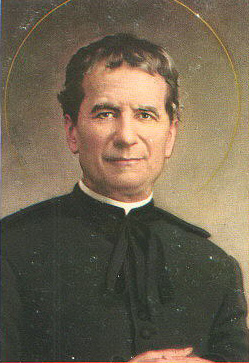
Don Giovanni Bosco
Altre Profezie
Elisabetta Canori
Catherine Emmerich
Suor Gabriella
Gioachino da Fiore
Jacob
Lorber
Saint
Malachia
Rasputin
Suor Ali'
Anna Maria Taigi
The Archangels
Maria Valtorta
The Virgin of Naju
|
By clicking from the top links you can
access pages relating to some very famous mystics |
|
|
|
|
Read my blog below, or check it
online at:
|
|
Mario Freedom's Space |
|
Note: All reasonable
attempts have been made to contact the copyright
holders of any images that are not either the author's own, kindly
made available to him or already in the public domain.
We would be grateful if any whom we have been unable
to contact would get in touch with us.
|
|
Don Giovanni Bosco
John Bosco was born on the 16th of August 1815, in Becchi, a
hamlet belonging to the municipality of Castelnuovo d'Asti
(today Castelnuovo Don Bosco). He came from a family of poor
farmers. He lost his father, Francesco, at the age of two.
His mother Margherita raised him with tenderness and energy.
She taught him to cultivate the soil and to see God behind the
beauty of the heavens, the abundance of the harvest, the rain
which showered the vines. Mamma Margherita, in the church,
learned to pray, and she taught her children to do the same.
For John, to pray meant to speak with God on his knees on the
kitchen pavement, to think of him while seated on the grass,
gazing at the heavens.
From his mother, John learned to see God also in other faces,
those of the poor or those of the miserable ones who came
knocking at the door of the house during winter, and to whom
Margherita gave hot soup, mended shoes.
 The great dream
At the age of nine, Don Bosco had the first, great dream which
marked his entire life. He saw a multitude of very poor boys
who play and blaspheme. A Man of majestic appearance told him:
With meekness and charity you will conquer these your friends;
and a Lady just as majestic added: Make yourself humble,
strong and robust. At the right time you will understand
everything.
The years which followed were given direction by that dream.
Son and mother saw in it the indication of a way of life.
John tried immediately to do good for boys. When the visiting
performers trumpet announced a local feast in the nearby
hills, John went and sat in the front row to watch them. He
studied the jugglers, tricks and the acrobats secrets. One
Sunday evening, John gave his first performance in front of
the kids from the neighbouring houses. He performed balancing
miracles with pots and pans on the tip of his nose. Then he
jumped up on a rope strung between two trees, and walked on it
applauded by the young spectators. Before the grandiose
conclusion, he repeated for them the sermon he heard at the
morning Mass, and invited all to pray. The games and the Word
of God began transforming his little friends, who willingly
prayed in his company.
Little John understood that to do good for so many boys he
needed to study and become a priest. But his brother Anthony,
already 18 and an unlettered peasant, did not want to hear of
this... He threw away his books and belted him.
On a cold morning of February 1827, John left his home and
went to look for work as a farm-servant. He was only 12 but
life at home was unbearable on account of the continuous
quarrels with Anthony. He worked on the Moglia farm, near
Moncucco, during three years. He led the cattle to pasture,
milked the cows, put fresh hay in the manger, plowed the
fields with the oxen. During the long nights of winter time
and during summer, sitting under the trees while the cows
stripped their leaves, he went back to his books and studies.
Anthony married three years later. John returned home and
resumed his schooling, first at Castelnuovo and then at Chieri.
To provide for his needs he learnt different trades: tailor,
blacksmith, barman, and he even coached students after
classes.
He was intelligent and brilliant, and the best students of the
school flocked around him. He founded what was known as the
Happy Club.
At 20 years of age, John Bosco took the most important
decision of his life: he entered the Seminary. There followed
six years of intense studies after which he was ordained
priest.
He becomes Don Bosco
On June 5, 1841, the archbishop of Turin ordained John Bosco a
priest. Now Don Bosco (in Italy the family name of the priest
is preceded by Don) was finally able to dedicate himself full
time to the abandoned boys he had seen in his dreams. He went
to look for them in the streets of Turin. On those first
Sundays - says young Michael Rua, one of the first boys he met
in those first months, Don Bosco went through the city to
become aware of the moral conditions of the young. He was
shocked. The outskirts of the city were zones of turmoil and
revolution, places of desolation. Unemployed, sad and ready to
do anything adolescents caused problems on the streets. Don
Bosco could see them betting on street corners, their faces
hard and determined, as if to get their way at any cost.
Near the city public market (Turin had a population of 117.000
inhabitants at that time) he discovered a real market of young
workers. The part near Porta Palazzo, he wrote years later
swarmed with peddlers, shoe polishers, stable-boys, vendors of
any kind, errand boys: all poor people who barely eked out a
living day after day. These boys who roamed the streets of
Turin were the wicked effect of an event that was throwing the
world into confusion: the industrial revolution. This started
in England but it soon crossed the English Channel and made
its way to the South. It would bring a sense of well-being
unheard of in previous centuries, but it would be at a very
high human cost: the labour question and the gathering of
great number of families below the poverty line in the slums
of the cities, coming in from the countryside in search of a
better life.
Boys in prison
But Don Bosco met the most dramatic situation when he entered
the prisons. he wrote: To see so many boys, from 12 to 18
years of age, all healthy, strong, intelligent, insect bitten,
lacking spiritual and material food, was something that
horrified me. In the face of such a situation he made his
decision: I must by any available means prevent boys ending up
here. There were 16 parishes in Turin. The parish priests were
aware of the problem of the young but they were expecting them
to go to the sacristies and to the Churches for the required
catechism classes. They did not realize that because of
population growth and migration to the city this way of doing
things was inefficient. It was necessary to try new ways, to
invent new schemes, to try another form of apostolate, meeting
the boys in shops, offices, market places. Many young priests
tried this.
Don Bosco met the first boy on December 8, 1841. He took care
of him. Three days later there were nine, three months later
twenty five and in summer eighty. They were pavers,
stone-cutters, masons, plasterers who came from far away
places, he recalled in his brief Memoirs.
Thus was born the youth centre (which he called oratorio).
This was not simply a charitable institution, and its
activities were not limited to Sundays. For Don Bosco the
oratorio became his permanent occupation and he looked for
jobs for the ones who were unemployed. He tried to obtain a
fairer treatment for those who had jobs, he taught those
willing to study after their days work.
But some of his boys did not have sleeping quarters and slept
under bridges or in bleak public dormitories. Twice he tried
to provide lodgings in his house. The first time they stole
the blankets; the second they even emptied the hay-loft.
He did not give up though, being the obstinate optimist he
was. In the month of May, 1847, he gave shelter to a young lad
from Valesia, in one of the three rooms he was renting out in
the slums of Valdocco where he was living with his mother. I
had three lira when I arrived in Turin said the boy sitting
near the fire, but I found no work and no place to sleep.
Money problems
After the youngster from Valsesia, another six boys arrived
that same year. In the first months money became a dramatic
problem for Don Bosco. It would remain a problem throughout
his life. His first benefactor was not a countess but his
mother. Margaret (Mamma Margherita), a 59 year old poor
peasant, had left her house at Becchi to become mother to
these poor boys. To be able to put something on the table, for
them to eat, she sold her wedding ring, her earrings and her
necklace, things which she had kept jealously until then. The
boys sheltered by Don Bosco numbered 36 in 1852, 115 in 1854,
470 in 1860 and 600 in 1861, 800 being the maximum some time
later.
Some of these boys decided to do what Don Bosco was doing,
that is, to spend their lives in the service of abandoned
boys. And this was the origin of the Salesian Congregation.
Among the first members we find Michael Rua, John Cagliero
(who later became a Cardinal), John Baptist Francesia.
In the archives of the Salesian Congregation some
extraordinary documents, are to be found, such as: a contract
of apprenticeship on ordinary paper, dated November 1851;
another one on stamped paper costing 40 cents, dated February
8, 1852; there are others with later dates. These are among
the first contracts of apprenticeship to be found in Turin.
All of them are signed by the employer, the apprentice and Don
Bosco.
In those contracts Don Bosco touched on many sore spots. Some
employers made servants and scullery-boys of the apprentices.
Don Bosco obliged them to employ them only in their
acknowledged trade. Employers used to beat the boys. Don Bosco
required of them that corrections be made only through words.
He cared for their health, he demanded that they be given rest
on feast days, that they be given their annual holidays. But
in spite of all the efforts and contracts, the situation of
the apprentices of the time remained very difficult.
Bashing leather and pushing an awl
In autumn 1853 Don Bosco came to a decision. He begun
shoemaking and tailoring shops in the Oratory at Valdocco. The
shoemaking shop was located in a very narrow place near the
bell-tower of the first church he had just finished building.
There Don Bosco sat at a cobblers bench and in front of four
little boys he pounded away at a leather sole. Then he taught
them how to manage an awl and pack-thread.
After these shops for shoemakers and tailors, Don Bosco built
other shops aimed at training book-binders, carpenters,
printers and mechanics; six shops in which the privileged
place was reserved for orphans, the poor and totally abandoned
boys. To take care of these shops Don Bosco invented a new
type of religious: the Coadjutors or Salesian Brothers.
Similar shops were very soon built in other Salesian presences
outside Turin. The Salesian Brothers have the same dignity and
rights as those of the Salesian Priests and clerics, but they
are specialized people for professional schools. (At the time
of Don Bosco's death, the Salesian professional schools
numbered 14 in all. They existed in Italy, France, Spain and
Argentina. The number later would grow to 200 across the
world).
Password: At once
In the dialogue between Don Bosco and the first boy (he
himself wrote this dialogue) there is the expression at once.
It looks like an ordinary expression but in reality it is Don
Bosco's password. In fact Don Bosco is drawn to action by the
urgent needs of the young and the impossibility of waiting any
longer. In the face of the incertitude of the industrial
revolution, in the impossibility of finding good and ready
made plans and programs of action, Don Bosco and the first
Salesians used all their energies to do something at once for
young people in trouble. What directed their programs of
action were the urgent needs of the youngsters.
And young people needed a school and a job that would
guarantee a more secure future for them; they needed to feel
as if they were really boys, that is, they needed to let loose
their desire to run and jump in open green spaces, instead of
feeling sad beside city sidewalks; they needed to meet God to
discover and live according to their dignity. Bread,
catechism, professional training and work protected by a good
work contract were the things therefore that Don Bosco and his
Salesians tried to offer right away to these youngsters. If
you come upon somebody who is dying of hunger, instead of
giving him a fish, teach him how to fish, it has rightly been
said. But the contrary is also true: If you come upon somebody
dying of hunger, give him a fish so that he may have the time
to learn how to fish. Immediate intervention is not enough nor
is it enough to prepare a different future because meanwhile
the poor may die of misery.
I
have done nothing
In the following years, Don Bosco, working almost to
exhaustion, accomplished many imposing works. Besides the
Salesians, he founded the Daughters of Mary Help of Christians
and the Salesian Cooperators. He built the Sanctuary of Mary
Help of Christians at Valdocco and founded 59 Salesian houses
in six nations. He started the Salesian Missions in Latin
America sending there Salesian priests, brothers and sisters.
He published a series of popular books for ordinary Christians
and for boys. He invented a System of Education founded on
three values: Reason, Religion and Loving kindness. Very soon
people saw in it an ideal system to educate the young. When
somebody would tell Don Bosco the list of the works he
performed, he would interrupt the person and immediately say:
I have done nothing by myself. It is the Virgin Mary who has
done everything. She had traced out his road in the famous
dream he had when he was nine.
Don Bosco died on January 31, 1888, at dawn. To the Salesians
who were keeping vigil around his bed he said in a whisper
these last words: Love each other as brothers. Do good to all
and evil to none... Tell my boys that I wait for them all in
Paradise.
Don Bosco's message
After one hundred years Don
Bosco has still a message for any youngster. The following
could be his words:
I was a person like you. I tried to give meaning to my life.
With God's help I decided against having my own family to
become a father, a brother and a friend to those who do not
have a father, brothers or friends.
If you want to be like me we will walk together sharing our
life with people living in South American shanty towns, with
lepers in India or with so many poor people living in the
slums of an Italian city: people deprived of affection, of
meaning in life, poor people who need God and you to go on
living. In any case, if you do not feel like living as I did,
I still want to remind you of a very important truth: life,
this great gift which comes from God, is to be spent well. You
will spend it well if you do not hide egoistically in your
shell but open yourself to love, committing yourself to the
good of the one who is poorer than you.

The First Prophecy
God alone is almighty,
all-knowing, all-seeing. God has neither past nor future;
everything is present to Him, everything at a single point of
time. Nothing eludes God. No person, no place is distant from
Him. In His infinite mercy and for His glory He alone can
unveil the future to man.
On the vigil of the Epiphany of this year, 1870,2
all material things in my room disappeared, and I found myself
contemplating supernatural matters. It was only a matter of an
instant, but I saw a great deal. Although what I witnessed was
sensibly present, I find it extremely difficult to communicate
it to others intelligibly, as one may realize by what follows.
This is the Word of God in human parlance:
"War will come from the south,3
peace from the north.4
"The laws of France no longer recognize the Creator. The
Creator will reveal Himself by visiting her three times with
the scourge of His wrath.5
The first time He will destroy her pride by defeat, pillage,
and destruction of crops, cattle, and men.6
On His second visit the great whore of Babylon, which the
faithful grievingly call Europe's brothel, shall lose her
leader and fall prey to chaos.7
"Paris! Paris! Instead of fortifying yourself with the Lord's
name, you surround yourself with houses of ill repute. You
yourself shall destroy them; your idol, the Pantheon, will be
razed to the ground,8 so
that it may truthfully be said that 'iniquity has lied to
itself.' [Ps. 26,12] Your enemies will plunge you into
anguish, famine, terror, and the contempt for My law, says the
Lord.
"On My third visit, you shall fall under the foreign yoke.
From afar your enemies will see your palaces in flames, your
home in ruins, soaked in the blood of your heroes who are no
more.9
"But behold, a great warrior from the north appears,10
a banner in his right hand, his arm bearing this inscription:
'Irresistible is the hand of the Lord.'11
At that moment the Venerable Old Man of Rome went forward to
meet him, wielding a flaming torch.12
The banner then grew larger and its blackness became white as
snow;13 in its center
stood out the name of the Almighty in golden letters.14
"The warrior (Don Carlos and the Pope) and
his followers bowed profoundly to the Venerable Old Man and
joined hands with him.15
16"Now the voice of
Heaven is addressed to the Shepherd of Shepherds. (To
Pius IX) You are in solemn conference with your co-workers
(the Vatican Council),17
but the enemy of good never stands idle. He cunningly plots
and sets all his wiles against you. He will sow discord among
your helpers and will rear enemies among My sons. (The
grave frustrations [suffered by Pius IX]
during the Vatican Council.) The powers of the world shall
vomit fire. They would love to smother My words in the throats
of the guardians of My law, but they shall not succeed. (This
has already been attempted and will still be attempted,
especially in Prussia.)18
They shall do much harm, but only to themselves. Hurry! If
knots cannot be untied, sever them. Do not halt in the face of
difficulties, but go forth until the hydra of error has been
beheaded (through the proclamation of the dogma
of papal infallibility).19
At this blow earth and hell shall tremble, but he world will
be saved20 and the
faithful shall exult. Gather around you only two co-workers,
yet wherever you go,21
carry on the task entrusted to you and bring it to completion
(the Vatican Council).22
Days go by swiftly and your years are reaching their appointed
number,23 but the great
Queen shall always assist you, and, as in the past, She shall
always be magnum et singulare in Ecclesia
praesidium [the powerful, prodigious defense of the
Church].24
"But you, O Italy, land of blessings, who has plunged you into
desolation? Not your enemies, but your own friends. Do you not
hear your children begging for the bread of faith, unable to
find one to break it for them? What shall I do? I shall strike
the shepherds and scatter the sheep so that those who sit upon
the chair of Moses may seek better pastures and their flock
may gently listen and be fed. (A seeming allusion
to inadequate religious instruction.)25
"But My hand shall be heavy upon both flock and shepherds.
Famine, plague, and war shall cause mothers to mourn the blood
of their sons and husbands shed on foreign soil.26
(A seeming allusion to this year's famine.
Pestilence and war shall follow.)
"What shall befall you, ungrateful, effeminate, proud Rome?
You have reached a point when you seek and admire nought in
your sovereign27 but
luxury, forgetting that both your glory and his lies on
Golgotha. Now he is old, frail, defenseless, and dispossessed.
(Present condition of Pius IX.) Nevertheless,
though captive, his words cause the whole world to tremble.28
"O Rome! Four times shall I come to you!29
The first time I shall smite your regions and its people. The
second time I shall bring slaughter and destruction to your
very gates. Should not that make you open your eyes? A third
time shall I come, and I will demolish your defenses and
defenders. (The present state of Rome.) At My
Father's30 command,
terror, dismay, and desolation will reign.
"My wise followers flee (many live away from
Rome, many are obliged to disperse), but My law is still
trod underfoot.31
Therefore, I shall come a fourth time.32
Woe to you if My law again shall go unheeded. There shall be
defections among both learned and ignorant. (This
has happened and is still happening.) Your blood and that
of your children shall wipe out your transgressions. (A
seeming allusion to some future disaster.)33
"War, plague, and famine are the scourges to smite human pride
and malice. (This summarizes the above-mentioned
punishments.) Where are your magnificent villas and
palaces, you people of wealth? (We shall see!)
They have become the litter of squares and streets!34
"And you priests, why are you not prostrate between the
vestibule and the altar, weeping and praying that the scourge
may cease?35 Why do you
not take up the shield of faith and preach My Word from the
rooftops, in the houses, streets, and squares, and even in
inaccessible places? Do you not know that this is the terrible
two-edged sword which smites My enemies and placates the wrath
of God and man?
"These things shall inexorably come to pass, all in
succession.36
"Things follow too slowly upon each other, but the great Queen
of Heaven is at hand; the Lord's power is Hers. Like mist She
shall scatter Her enemies.37
She shall vest the Venerable Old Man with all his former
garments.38
"There shall yet come a violent hurricane.39
Iniquity is at an end, sin shall cease, and before two full
moons shall have shone in the month of flowers,40
the rainbow of peace41
shall appear on the earth.
"The great Minister shall see the Bride of his King clothed in
glory.42
"Throughout the world a sun so bright shall shine43
as was never seen since the flames of the Cenacle until today,
nor shall it be seen again until the end of time."
The Second Prophecy
(May
24 - June 24, 1873)44
It was a dark
night (error), and men could no longer find
their way back to their own countries.45
Suddenly a most brilliant light (faith in God and
in His power) shone in the sky, illuminating their way as
at high noon.46 At that
moment from the Vatican came forth, as in procession, a
multitude of men and women, young children, monks, nuns, and
priests, and at their head was the Pope.47
(It seems to allude to the suppression of
monasteries and schools run by religious and to the Pope's
exile.)
But a furious storm broke out, somewhat dimming that light, as
if light and darkness were locked in battle.48
(Perhaps this means a battle between truth and
error, or else a bloody war.) Meanwhile the long
procession reached a small square littered with dead and
wounded, many of whom cried for help.49
The ranks of the procession thinned considerably.50
After a two-hundred day march, all realized that they were no
longer in Rome.51 In
dismay they swarmed about the Pontiff to protect him and
minister to him in his needs.52
At that moment two angels appeared, bearing a banner which
they presented to the Supreme Pontiff, saying: "Take the
banner of Her who battles and routs the most powerful armies
on earth. Your enemies have vanished: with tears and sighs
your children plead for your return."53
One side of the banner bore the inscription: Regina sine labe
concepta [Queen conceived without sine], and the other side
read: Auxilium Christianorum [Help of
Christians].54
The Pontiff accepted the banner gladly, but he became
distressed to see how few were his followers.55
But the two angels went on: "Go now, comfort your children.
Write to your brothers scattered throughout the world that men
must reform their lives.56
This cannot be achieved unless the bread of the Divine Word is
broken among the peoples.57
Teach children their catechism58
and preach detachment from earthly things.59
The time has come," the two angles concluded, "when the poor
will evangelize the world. Priests shall be sought among those
who wield the hoe, the spade, and the hammer, as David
prophesied: 'God lifted the poor man from the fields to place
him on the throne of His people.'"60
On hearing this, the Pontiff moved on,61
and the ranks began to swell. Upon reaching the Holy City, the
Pontiff wept at the sight of its desolate citizens, for many
of them were no longer.62
He then entered St. Peter's and intoned the Te
Deum,63 to which a
chorus of angels responded, singing: Gloria in excelsis Deo et
in terra pax hominibus bonae voluntatis [Glory to God in the
highest, and peace on earth to men of good will.] When the
song was over, all darkness vanished and a blazing sun shone.64
The population had declined greatly in the cities and in the
countryside; the land was mangled as if by a hurricane and
hailstorm, and people sought each other, deeply moved, and
saying: Est Deus in Israel [There is a God in
Israel].65
From the start of the exile until the intoning of the
Te Deum, the sun rose 200 times. All the
events described covered a period of 400 days.66
NOTE
The person reporting these things is the same who unerringly
predicted what happened to France a year before it took place.
These predictions were widely known and were fulfilled day by
day, as if a script were being followed.
According to this same person, France, Spain, Austria and a
German power would be the instruments of Divine Providence in
preventing the collapse of civil society and restoring peace
to the Church which for so long and in so many way has been
fought against. These event would start in the spring of 1874
and would be completed within a year and a few months, unless
new iniquities should be perpetrated against God's will.67
Thus says the
Lord to the emperor of Austria: "Be of good cheer and look
after My faithful servants and yourself. My wrath is now
spilling over all the nations because they want to make people
forget My laws, glorifying those who defile them and
oppressing My faithful adherents. Will you be the rod of My
power? Will out carry out My inscrutable design and become a
benefactor of the world? Rely on the Northern Powers, but not
on Prussia. Enter into relations with Russia, but form no
alliance. Join forces with Catholic France; after France, you
shall have Spain. All together, become one in will and action.68
"Observe absolute secrecy with the enemies of My holy name.
Prudence and vigor will make you and your allies invincible.
Do not believe the lies of whoever tells you otherwise. Abhor
the enemies of the Cross. Put your hope and trust in Me. I
make armies victorious. I am the Savior of nations and
sovereign. Amen. Amen."
Note: This letter was sent to the emperor of Austria in July
1873 through a trusted person who delivered it to him in
person. He read it attentively and sent his hearty thanks to
the sender, saying that he would avail himself of it.69
FOOTNOTES
1 Transcribed from The
Biographical Memoirs of Saint John Bosco by Rev.
Angelo Amadei, S. D. B., ed. Rev. Diego Borgatello, S. D.
B., Volume X (1871-1874), Salesiana Publishers, New
Rochelle, New York, 1977, pp. 49-59. Items in square []
brackets have been added by the Editor. Items in round ( )
brackets are the marginal notes added by St. John Bosco.
The two introductory paragraphs were written by the Saint.
2 i.e. January 5, 1870 A.D.. A copy of
this prophecy was sent to Rome on February 12, 1870, as
testified to by the Civiltá Cattolica,
Vol. VI, Series 8, 1872, pp. 299 and 303. Father Joachim
Berto copied this prophecy at Don Bosco request a few
weeks after Epiphany. His own comments on its meaning
however do not date to this period (cf. fn. regarding
"Pantheon."
3 According to Father Joachim Berto, the
priest to whom a copy of these prophecies was entrusted,
"from the south" refers to "From France, which declared
war on Prussia." This is reference to the Franco-Prussian
War of 1870-71. France declared war on Prussia on July 15,
1970 after Marshall Juan Prim (1814-1870), the
anti-clerical Prime Minister of Spain made a tentative
offer of the vacant throne of his nation to the German
prince, Leopold of Hohenzollern-Sigmaringen. Leopold, from
an obscure branch of the House of Hohenzollern, was the
brother of Stephenie the wife of Peter V, King of Portugal
(1855- 1861), as well as the husband of his brother
Antonia (1845-1913). The prospect of Spain allied with
Bismarck's Prussia led Napoleon III to initiative the
conflict which would have disastrous consequences for
France. Since the immediate occasion of the war derived
from Spain's interregnum, Fr. Berto would have been more
justified in saying "From Spain, where the war began."
However many historians consider the war to have begun by
the clever diplomatic maneuvers of Otto von Bismarck,
which enticed Napoleon III into war. Leopold himself,
knowing of Napoleon III's opposition to his candidature
for the throne of Spain voluntarily withdrew himself
before hostilities broke out. Hence it does not seem clear
that this phrase refers at all to the Franco-Prussian War
of 1870, despite Father Berto's interpretation. Regarding
the clarifications made by Fr. Berto (which will be noted
in the course of the text), Father Giovanni Battista
Lemoyne, S.D.B, who wrote vols. I-IX of the
Biographical Memoirs, says of them "evidently written
or previously dictated and then revised by Don Bosco. The
marginal notes and clarification shed light on and
pinpointed the predicted events which, to a large extent,
as we shall see, took place shortly afterward, though a
few, at the time of writings [1917], have still to occur.
Seemingly, according the Don Bosco, these were to take
place about the year 1874, 'unless,' as he wrote in his
own hand, 'new iniquities further provoke God.' We must
add that, when questioned later about the fulfillment of
these events, Don Bosco said frankly that they might not
take place, for in His mercy the Lord sometimes points out
to men the path they should follow in one circumstance or
another in order to get out of some difficulty, and
nothing more. If the direction given are not followed, it
is obvious that what has been foretold [and is contingent
upon them] will not occur either." (Vol. IX, p. 377)
4 On this phrase, Fr. Berto writes "From
the north of Spain where the present war began.
Furthermore, Don Carlos resided in Vienna, which is north
of Italy." The Don Carlos referred to here was the great
nephew of Don Carlos Maria Isidoro of Borbón (1848-1909),
Duke of Madrid, the second son of King Charles IV, who
contested the succession of his niece Isabella II in 1833.
Don Carlos like his great uncle were devout Roman
Catholics who much opposed the liberalism of their day.
The Duke of Madrid, who took up the claim to the throne
after the deposition of Isabella in 1868, undertook two
failed insurrections in 1869 and 1872. Later he fought a
bloody campaign (1873-1876) which was defeated by the
forces of King Alfonso XII, Isabella's son. Since the
Franco-Prussian War was concluded by an armistice signed
at Frankfurt on May 10, 1871 (there had been a previous
armistice at Paris on January 26, 1871), and not from
Spain where hostilities continued until 1876, peace did
come from the north. Once again the comments provided by
Fr. Berto are inaccurate.
5 It is sobering to note that God the
Creator reveals Himself to disbelievers through
punishments in history. This accords with what St.
Alphonsus says of the Divine Providence, which metes out
even temporal punishments in accord with the sins of the
age.
6 Following the temporal sequence, this
first visitation would be the Franco-Prussian war of
1870-1, in which eastern France was overrun by the
Prussian army and Paris besieged.
7 This second visitation refers to the
Communist Revolt in the spring of 1871, in which the
"communards" burnt much of the city and executed the
Archbishop of Paris.
8 Here Father Berto writes in the
Clarifications subjoined to this prophecy: "Contemporary
newspapers reported that it was damaged by several bombs.
But what concerns France has not yet fully take place."
This statement can only be understood has having been
written at least after January 5, 1871, when the Prussian
forces under General Moltke began the bombardment of
Paris. However the Pantheon most likely suffered damage
during the Communist revolt which broke out in the city on
March 17-18 of that year and whose resistance to the
French Government resulted in a second bombardment of the
city on April 2. A bloody week of city fighting (May
21-28) culminated in the slaughter of 20,000 communists.
During their rebellion may public buildings were burned,
there were two attempts to blow up the Cathedral of
Chartres and the Pantheon, and many hostages including the
Archbishop of Paris were executed (an event revealed
earlier to St. Margaret Mary Alaqoque, by Our Lady.)
9 The only time Paris was taken by a
hostile power was on June 14, 1940, when the armies of
Hitler's Third Reich took the city without a shot being
fired (it had been declared an open city just the day
before.) On the other hand, this third visit may refer to
the German occupation during the armistice period of the
Franco-Prussian war. During the revolt of the communists
in the spring of 1871, in which much of the city was burnt
and thousands slaughtered, the German troops of occupation
stood by as spectators to the struggle. The German
occupation lasted until Sept. 16, 1873, when France had
repaid its war indemnity.
10 Here Fr. Berto writes, "Don Carlos
from northern Spain." And Fr. Amadeus, the author of the
Biographical Memoirs, added at this
point, "Later on, Father Berto (so it seems) added a
question mark and these words: "No. Emperor William [I] of
Prussia." This latter comment contradicts Don Bosco's
marginal note which follows (Don Carlos and the Pope).
Indeed it is inconsistent with Emperor William's liberal
Protestantism do bear such an arm-band, or such a banner.
Don Carlos, on the other hand, began his final campaign
for the throne of Spain in 1873. This would correspond to
the sequence of events in the prophecy, which just
referred to the German occupation that ended in the
previous year.
11 Although all Fr. Berto's comments in
the Clarifications follow the sequence of the text, the
final comment returns to this passage: "Newspapers say
that Don Carlos apparently began his exploits without
weapons, money or victuals, and only with fourteen men.
Yet today, April 1, 1874, he has an army over 100,000
strong. There is no report as yet that he has lost a
single battle." Don Carlos campaign for the throne of
Spain ended in defeat in February of 1876; at which time
he fled to France.
12 Here Fr. Berto writes, "Faith in God
which guides and upholds the great warrior in his
undertakings." The metaphor the light of faith is
traditional in Catholicism. In 2 Peter 1:19 the prophetic
word of God revelation is called "a light shining in a
dark place." Hence perhaps the reason for Fr. Berto's
usage. As a devout Catholic who was attempting to restore
a Catholic government to Spain, Don Carlos' encounter with
the Pope would be true symbolically, even if it did not
actually take place.
13 Here Fr. Berto writes, "The massacre
ceased. Blackness a symbol of death or persecution, such
as the Kulturkampf." The
Kulturkampf (= 'The Conflict of Cultures') was a
series of anti-Catholic measures undertaken by Otto von
Bismarck to curb the rise of Catholic opposition to the
liberal policies of the Prussian government in Germany.
Begun in July of 1871, its measures gradually fell into
abeyance after the Catholic Center party significantly
increased its representation in the parliamentary
elections of 1878. The Kulturkampf is
another reason by Emperor William of Prussia could not
possibly be the 'great warrior' of this prophecy. This
statement, presumably by Fr. Berto, must therefore have
been written at or after July of 1871.
14 Here Fr. Berto writes, "According to
press reports, Don Carlos' banner bears on one side a
picture of the Heart of Jesus and on the reverse that of
the Immaculate Conception."
15 Perhaps a reference to Don Carlos'
intention not to recognize the seizure of the Papal
States. Isabella II, the former ruler of Spain, had
acceded to the demands of the libertarians and recognized
the Italian Republic, and its implicit seizure of the
Papal States—an action which her court chaplain, St.
Anthony Marie Claret y Claret, had warned would bring down
God's wrath upon her regime and nation. Within a year she
had to flee for her life to France during a revolution
engineered by the same liberal factions.
16 This section, which ends with "magnum
et singulare in Ecclesia praesidium" is the excerpt—not
originally included in the copies—which Don Bosco himself
read to Pope Pius IX during a private audience on February
20, 1870.
17 That is, the First Vatican Council,
which was held from December 8, 1869-Sept 1, 1870.
18 Don Bosco's marginal note refers
undoubtedly to the Kulturkampf of
Bismarck.
19 By terming the spirit which opposed
the Dogma of Papal Infallibility "the hydra of error" a
clear indication of the wickedness of schism, dissent and
Protestantism is indicated.
20 That is, from the loss of true
doctrine.
21 Here Father Berto comments, "
Seemingly an allusion to the Pope's exile. See the second
Prophecy." The Second Prophecy refers to the 200 day
March, which Fr. Berto interprets as an actual exile, in
accord with the history of the events of 1848 when Ven.
Pope Pius IX was forced to flee to the nearby city-port of
Gaeta, in the Kingdom of Naples. That first exile came
immediately after the Pontiff had written to all the
Bishops of the Church to solicit their comments regarding
the Dogma of the Immaculate Conception. During his exile
the Pope had visited the ancient shrine of La Madonna di
Civiltá, which is nearby Gaeta. Its Image was itself
rescued from the storms of Iconoclasm in Constantinople in
the 8th Century, by monks fleeing to Sicily. Hence the
shrine was a poetic refuge for the Pope who would soon
enshrine the Dogma of the Immaculate Conception among the
teachings of the Church. On this same phrase "wherever you
go", Fr. Amadeus, the author of volume X of the
Biographical Memoirs of St. John Bosco,
writes,"The first prophecy has these words for the Pope:
"Wherever you go . . ." It was, indeed taken for granted
that the Pope would leave Rome. He did not, however, and
this was due precisely to this message from Don Bosco:
"Let the sentry, the angel of Israel, remain at his post
and guard God's stronghold and His holy ark." The solemn
tone of these words clearly reveals their source.
Nor did the Pope ever forget them! While even Catholics
continued to believe that his departure from Rome was
imminent, Don Bosco, to the astonishment of all, hastened
to defend the rights of the Church and of the Supreme
Pontiff so effectively that the latter was able to appoint
bishops for more than a hundred vacant Italian diocese
without governmental interference....
And so the sentry of Israel remained at his post, guarding
God's rock. On his part, until the end of his days, Don
Bosco kept hoping and working zealously for a
reconciliation of Italy and the Church. "We are both of
the same age," he wrote to a fellow priest. "When we were
born Europe was settling down to peace after long years of
war. May we dare hope to see peace in the world and the
Church's triumph before the end of our lives? We could
then sing our Nunc dimittis. However, may
God's will be done in all things. The triumph of the
Church is certain; if we do not see it here below, we
shall witness it, I hope from heaven."
He did see it from heaven [in 1929] when the Lateran
Treaty was signed. [As Pius XI declared] it gave "God back
to Italy, and Italy back to God." The signing took place
just a month before Pius XI's proclamation of the
acceptance of the miracles which had been submitted for
Don Bosco's beatification.
In pointing out the "charming, admirable and striking
coincidence," the Pope characterized Don Bosco as a
"great, faithful and truly clear-sighted servant of the
Church and of the Holy See . . ." Such indeed he always
was! Pius XI then went on to state that he had learned
"from Don Bosco himself" how much "a solution of this
deplorable dissension was truly uppermost in his thoughts
and desires . . . a solution that would, above all,
guarantee the honor of God and of the Church, and the
welfare of souls." (cf. L'Osservatore Romano, March 20-21,
1929.)
22 A seeming reference that the work
begun by the First Vatican Council should have been
completed (at a future council?). This has still to come
about, since Vatican II took an entirely different
approach from the infallible, irreformable, declaratory
nature of its precursor.
23 Ven. Pope Pius IX died in February 7,
1878.
24 The Latin phrase is more exactly
translated as, "Great and Singular Defense in the Church."
25 The armies of the Italian Republic
took Rome on Sept. 20, 1870, after the French garrison,
which had been protecting the city, was recalled to France
to defend her. In the following year Pope Pius IX refused
the settlement offered by Victor Emmanuel II, the King of
Italy, and in retaliation the government seized
ecclesiastical property throughout the peninsula forcing
many religious to flee overseas.
26 Here Father Berto comments, "This has
still to come." And Father Amadeus adds, "Here too there
is a penciled addition: 'Dogali.' At Dogali, a small
locality about thirteen miles from Massaua, Eritrea, five
hundred Italian soldiers were ambushed and massacred in
1887." This is a reference to the victory of John IV,
Emperor of Abyssinia over the Italian colonial forces on
January 26, 1887. In 1896 another Italian force under
General Oreste Baratieri was defeated by Emperor Menelek's
forces at the battle of Aduwa: 6,500 Italians were killed
in action. Prior to these actions, no armed forced of the
new Republic of Italy had fought on foreign soil. This
penciled in comment, thus, must have been written after
January 26, 1887.
27 That is, the Roman Pontiff, who was
the temporal ruler of the city, at the time of this
prophecies composition in January of 1870.
28 A reference to the captivity which
Pope Pius IX imposed upon himself after the fall of Rome
in Sept. 1870. At the very moment that the Pope lost the
Papal States, God compensated him with the dogmatic
definition of Papal Infallibility, to which the end of the
sentence refers symbolically.
29 To be consistent with the text, these
visitations must occur at least after 1870, and more
precisely after the spring of 1871, when the Italian
government began to persecute the Church in Italy. Thus
the comment by Don Bosco "This refers to the present state
of Rome" is seemingly a note added in 1874, when the Saint
had Father Berto make a copy of the original manuscript.
On Sept. 20, 1870, 60,000 troops of the Republic under the
command of General Raffaele Cadorna invested Rome and
breached the city walls. The history of the following
period 1871-1874 does not correspond with the text, since
in June, 1871, Rome became the capital of the Republic and
enjoyed a period of peace, until it was captured by the
Allies in World War II on Sept. 4, 1944, without a shot
being fired. However during late July of 1943 the environs
of the city were bombarded by 500 allied bombers. These
four visitations thus remain obscure.
30 This statement clarifies the speaker
of the prophecy as Jesus Christ.
31 Perhaps a reference to the great
exodus of Catholic clergy and religious to North and South
America during this period.
32 Here Fr. Berto writes, "This visit to
Rome has still to take place." Perhaps a reference to the
sufferings endured by the city during the Second World
War.
33 This comment by Don Bosco indicates
that he himself did not understand precisely the
significance of the prophecy. But according to St. John of
the Cross, this is normally the case in such
circumstances, (cf. Ascent of Mount Carmel, Book II, nn.
9-10.) Since the citizens of Rome in both 1870 and 1944
did not suffer the loss of their lives from a direct
military attack on the city, this prophecy seems
unfulfilled. Not so, however, if it refers in a general
manner to the men from Rome who served in the wars which
followed 1870 (e.g. Eritrea, Ethiopia, World War I and
II).
34 Since the environs of Rome were
heavily damaged during 1943-44, this may be a reference to
these events. Rome did experience a period of the greatest
penury in the years 1944-6.
35 A sober reminder that the fulfillment
of priestly duties by the bulk of the clergy is the one
means of remedying God's wrath towards humanity.
36 Ostensibly a definitive indication
that this prophecy is given in chronological sequence, and
is to be thus interpreted.
37 That is, with the passing of time
which makes things forgotten, as objects gradually
obscured from view.
38 Perhaps a reference to the signing of
the Lateran Treaty of 1929, which settled the Roman
Question (the dispute between Italy and the Vatican
concerning the Papal States and the rights of the Church
in Italy) and ended the imprisonment of the Pope in the
Vatican. This interpretation would be most harmonious with
the chronological sequence of this prophecy. But if so
"former garments" is used in a very symbolic manner.
39 Here Fr. Berto writes, "See the next
prophecy where the hurricane is fully described." This
event must, therefore, follow the Lateran Treaty of 1929,
which is the resolution of the political events of
1870-74.
40 Here Fr. Berto writes, "This year,
1874, the month of May has two full moons, one on the 1st
and the other on the 31st." Fr. Berto interprets "month of
flowers" as a reference to May. However the when the wild
flowers bloom in Turin (the home of Don Bosco) is March.
Astronomical tables confirm Fr. Berto's assertion
regarding two full moon in May, 1874. However no
extraordinary event secular or supernatural occurred in
that month. Indeed following the sequence of the text,
this event should follow the "hurricane" of "iniquity" and
"sin" which itself would follow the Lateran Treaty of
1929. In March of 1988 and 1999 there are two full moons.
In the former there was no noticeable cessation to sin in
the world. The latter has yet to come.
41 Here Fr. Berto writes, "A hope which
seemingly is rising in Spain today, March 1, 1874." A
reference to the advances of the Carlist, Don Carlos, Duke
of Madrid (cf. notes above). This interpretation militates
against the statement of Don Bosco's prophecy just read,
"These things shall inexorably come to pass, all in
succession." since if Fr. Berto's assertion were correct,
this event would have occurred after others which he
himself admits have not yet happened. The following text
however refers to a spiritual event (a sun seen by the
whole world, that is comparable to the light of the
Cenacle) of the greatest significance to the Church. The
Miracle at Fatima is a candidate, since it is a light that
has shown throughout the world. But 1917 would be outside
the sequence, if the former interpretation of the Lateran
Treaty is correct. However if the phrase "former garments"
refers to an end of hostilities between the government of
Victor Emmanuel II which prevailed in the years 1871-4,
then the miracle at Fatima would seem appropriate, seeing
as it was an admirable fulfillment of St. John's prophecy,
"A great sign appeared in heaven, a woman clothed with the
sun." (Rev. 12:1)
42 This phrase strikingly bears the
imagery of Revelation 12:1 which was fulfilled in a
particular manner by the miracle of the sun at Fatima on
October 13, 1917. It is said that Pope Pius XII himself
was given a vision of this event; that would be the
literal fulfillment of this prophecy.
43 Here Fr. Berto writes, "Triumph and
growth of Christianity."
44 The title appear in the original
transcription. Father Berto first came to know of this
prophecy on July 14, 1873. Shortly thereafter Don Bosco
asked him to copy it and send it along with another
document to Franz Joseph I of Austria, King of Hungary and
Bohemia (cf. Biographical Memoirs, Vol.
X, p. 49).
45 An implicit description that the men
in question have convened together in a foreign land
during a period characterized by the prevalence of error.
46 The marginal notes (in italics) added
by Don Bosco evince his opinion that this prophecy
referred to a Pope's exile. No exile took place, which
perhaps lead Don Bosco to admit in 1871 that the prophecy
perhaps would never be fulfilled (Biographical
Memoirs, Vol X p. 377). Accordingly the only other
interpretation must take the imagery as symbolic of a
spiritual exile. If the imagery is consistent with the
previous prophecy, then this great light must have a
Marian character. Therefore the circumstances of this
prophecy appear to coincide with those of the Second
Vatican Council at which Bishops, in their capacity as
delegates to a non-infallible disciplinary synod, met
together. At the close of the Council (on November 21,
1965 the last documents where published) Pope Paul VI
proclaimed Mary "Mother of the Church." This perhaps is
the light referred to in the text above.
47 The phrase "as in procession" is
exact, since unlike a religious procession, which proceeds
from one sacred place to another, and which is headed by a
crucifer, thurifer and candlebearers, this column of
persons is headed by the Pope (as at it will be seen, out
of the City into the countryside). The Latin word
profanus, from which the English word
"profane" is derived, literally refers to the
non-consecrated area outside the domain of a sacred space.
It is interesting to note that the other participants in
the group are in reverse order (adults: children; male
religious: female religious). The clergy alone are where
they should be, indicating that they alone understand it
as a religious procession.
48 A clear reference to the revival of
Modernism which characterized the post-Conciliar period
and distinguished itself by attacking Marian devotions.
49 The "end" of the procession (actually
the mid-point) is a public square (a profane place). Those
found there perhaps symbolize the spiritual catastrophe
which overtook the Catholic world during the
"implementation" period. Certainly the last phrase
poignantly describes the efforts of the laity who remained
faithful.
50 Another apt description of the
reaction of the laity to Conciliar reforms in the period
following the Council, especially as the direction of the
reforms became clearer.
51 Taking the march in a spiritual and
symbolic sense, "Rome" must refer to "Roman Catholicism".
This statement therefore explicitly affirms that the post-Conciliar
reforms have lead to something other that Catholic truth
and life.
52 Another poignant description of the
reaction of the laity during the post-Conciliar period.
The phrase "to protect him" may refer to the assassination
attempt on the Pope on May 13, 1981, or a defense of the
Magisterium by personal initiatives.
53 It seems therefore that the "children"
whether still in Rome or with the Pope are one in calling
for his return to the City. The advent of the two angels
is a solemn indication of the intervention of Heaven to
change the course of "renewal" and may in fact refer to
some personal experience of the Roman Pontiff.
54 These two titles of Our Lady refers
unmistakably to the Immaculate Conception and Mary, who as
Mediatrix and Mother of the Church, watches over Catholics
to protect them. The acceptance of the banners perhaps
alludes to the consecrations of the world (not Russia) to
the Immaculate Heart on May 13, 1982 and March 25, 1984.
The imagery of accepting a banner signifies the entrance
into the service of a monarch. In this case that of Mary.
And if taken in conjunction with that of the former
prophecy's allusion to a vision of Our Lady in glory, then
this text would build on the prophecies related to Fatima.
55 A reference, no doubt, to the few who
share the Pontiff's devotion to the Mother of God.
56 Seemingly an Encyclical on Penance.
Pope John Paul II issued such an Encyclical (Reconciliatio
et Paenitentia) on December 2, 1984.
57 "Divine Word" is a phrase signifying
the Deposit of the Faith, Sacred Revelation. The image of
it being broken is a standard idiom for preaching.
58 The Universal Catechism was
promulgated by Pope John Paul II on the Solemnity of the
Immaculate Conception (a coincidence?), December 8, 1992.
59 Pope John Paul II has repeatedly
encouraged the youth to consider a religious vocation.
60 An allusion to the vocation crisis in
the First World.
61 The direction of the "procession"
reverses; and thus the faithful begin to rejoin the Pope.
62 A clear indication of the tremendous
damage done the Church Universal. The lack of citizens
indicative of eternal damnation, in as much as the City is
symbolic of "The True Faith."
63 The return to St. Peter's also must be
symbolic of a restoration of (return to) Romanism, which
is the Church founded by St. Peter. The intoning of the
Te Deum crowns the imagery, since this is
customary in the Traditional Roman Rite. The Angels
response indicates that the restoration, far from being
unwelcome, is in fact in accord with the Divine pleasure.
64 This blazing sun may be the same as
that of the previous prophecy. If so then its Marian
character is also necessary. Perhaps it refers to a coming
dogmatic definition of the Corredemption. This would be
consistent, since over 400 of the Bishops who attended
Vatican II requested this; and as can be seen from the
pontificate of John Paul II, he has striven closely to
complete the good intentions of Pope John XXIII and Paul
VI.
65 The spiritual climax and triumph is
welcomed by the laity, who have weathered the storm.
66 According to Fr. Frank Klauder, S.D.B.,
in his article "The 200 Day March: Don Bosco and the
Millennium," Soul Magazine, Jan./Feb. 1998, p. 6., the
chronology of this prophecy is also symbolic. One day
equates to one month. Four-hundred days represents 33
years 4 months, which is the time from November, 1965 (the
close of Vatican II) to March 1999, another month in which
there will be, in accord with the first prophecy, two full
moons. The first two-hundred day period marks the 16 years
8 months ending August 1982, which approximates the time
during the Pontificate of John Paul II when he began
publicly to speak of Our Lady as Corredemptrix (cf. Dr.
Mark Miravalle's book, The Final Dogma) and when he
decided to consecrate the world to the Immaculate Heart of
Mary. The "rainbow of peace" of the first prophecy would
then refer to the era of peace promised by Our Lady at
Fatima, when the world would follow the way of Her
Immaculate Heart. Although the sun rises 200 times, there
are 400 days, indicating that the time period here is not
measured literally but symbolically.
67 These events began in the spring of
1874, inasmuch as the conflict between the modern state
and the Church which began with the seizure of the Papal
States (as a symbolic retaliation for the definition of
the Dogma of Papal Infallibility) will be concluded by the
"triumph of the Church" which Don Bosco himself desired so
much. This "triumph," in order to counter-poise the events
of the prophecies, would necessarily include the
recognition of the Papacy's Authority in world affairs and
the establishment of a new arrangement between Church and
State, to succeed that destroyed by the revolutions of the
19th century. These prophecies undoubtedly are associated
with Don Bosco's more famous prophecy of the Two Columns,
which concludes with a Pope chaining the Bark of Peter to
Our Lady Help of Christians and the Most Blessed Sacrament
(Biographical Memoirs, Vol. VII, pp.
107-109.
68 At this point Fr. Berto added a note
ex post facto, "This prophecy fitted the
political situation in Europe that year. Later, things
changed, both in regard to France and to Prussia." This
prophecy is a Divine invitation for the Catholic nations
to unite to withstand the Masonic-Protestant alliances of
nations in Europe. However, headless of this request,
Austria-Hungary eschewed political alliances with France
and Spain for the next 25 years, thus laying the
groundwork politically for the system of agreements that
precipitated the First World War. Ironically, and
treacherously at that, only Catholic Austria-Hungary was
partitioned into oblivion by the treaty of Versailles;
even though she alone had been the most forceful voice for
peace throughout the entire war.
69 Here Fr. Amadeus writes, "Here he [Don
Bosco] added the name of the trusted person—Countess
Lutzow, and admirer of his. On June 14 of that year she
had sent him a 2,000 lire donation in thanks for her
husband's recovery through the intercession of Mary, Help
of Christians."
Vision
Of hell
On Sunday night, May 3 [1868], the feast of Saint Joseph's
patronage, Don Bosco resumed the narration of his dreams:
I
have another dream to tell you, a sort of aftermath of those I
told you last Thursday and Friday which totally exhausted me.
Call them dreams or whatever you like. Always, as you know, on
the night of April 17 a frightful toad seemed bent on
devouring me. When it finally vanished, a voice said to me:
"Why don't you tell them?" I turned in that direction and saw
a distinguished person standing by my bed. Feeling guilty
about my silence, I asked: "What should I tell my boys?"
"What you have seen and heard in your last dreams and what you
have wanted to know and shall have revealed to you tomorrow
night!" He then vanished.
I
spent the whole next day worrying about the miserable night in
store for me, and when evening came, loath to go to bed, I sat
at my desk browsing through books until midnight. The mere
thought of having more nightmares thoroughly scare me.
However, with great effort, I finally went to bed.
-
"Get up and follow me!" he
said.
-
-
"For Heaven's sake," I
protested, "leave me alone. I am exhausted! I've been
tormented by a toothache for several day now and need rest.
Besides, nightmares have completely worn me out." I said
this because this man's apparition always means trouble,
fatigue, and terror for me.
-
-
"Get up," he repeated. "You
have no time to lose."
-
-
I complied and followed him.
"Where are you taking me?" I asked.
-
-
"Never mind. You'll see." He
led me to a vast, boundless plain, veritably a lifeless
desert, with not a soul in sight or a tree or brook.
Yellowed, dried-up vegetation added to the desolation I had
no idea where I was or what was I to do. For a moment I even
lost sight of my guide and feared that I was lost, utterly
alone. Father Rua, Father Francesia, nowhere to be seen.
When I finally saw my friend coming toward me, I sighed in
relief.
-
-
"Where am I?" I asked.
-
-
"Come with me and you will
find out!"
-
-
"All right. I'll go with you."
-
-
He led the way and I followed
in silence, but after a long, dismal trudge, I began
worrying whether I would ever be able to cross that vast
expanse, what with my toothache and swollen legs. Suddenly I
saw a road ahead. "Where to now?" I asked my guide.
-
-
"This way," he replied.
-
-
We took the road. It was
beautiful, wide, and neatly paved. "The way of
sinners is made plain with stones, and in their end is hell,
and darkness, and pains. " (Ecclesiasticus 21: 11,
stones: broad and easy.) Both sides were lined with
magnificent verdant hedges dotted with gorgeous flowers.
Roses, especially, peeped everywhere through the leaves. At
first glance, the road was level and comfortable, and so I
ventured upon it without the least suspicion, but soon I
noticed that it insensibly kept sloping downward. Though it
did not look steep at all, I found myself moving so swiftly
that I felt I was effortlessly gliding through the air.
Really, I was gliding and hardly using my feet. Then the
thought struck me that the return trip would be very long
and arduous.
-
-
"How shall we get back to the
Oratory?" I asked worriedly.
-
-
"Do not worry," he answered.
"The Almighty wants you to go. He who leads you on will also
know how to lead you back."
-
-
The road is sloping downward.
As we were continuing on our way, flanked by banks of roses
and other flowers, I became aware that the Oratory boys and
very many others whom I did not know were following me.
Somehow I found myself in their midst. As I was looking at
them, I noticed now one, now another fall to the ground and
instantly be dragged by an unseen force toward a frightful
drop, distantly visible, which sloped into a furnace. "What
makes these boys fall?" I asked my companion.
"The proud have hidden a net for me. And they have stretched
out cords for a snare: they have laid for me a
stumbling-block by the wayside." (Psalms 139: 6)
-
-
"Take a closer look," he
replied.
-
-
I did. Traps were everywhere,
some close to the ground, others at eye level, but all well
concealed. Unaware of their danger, many boys got caught,
and they tripped, they would sprawl to the ground, legs in
the air. Then, when they managed to get back on their feet,
they would run headlong down the road toward the abyss. Some
got trapped by the head, others by the neck, hand, arms,
legs, or sides, and were pulled down instantly. The ground
traps, fine as spiders' webs and hardly visible, seemed very
flimsy and harmless; yet, to my surprise, every boy they
snared fell to the ground.
-
-
Noticing my astonishment, the
guide remarked, "Do you know what this is?"
-
-
"Just some filmy fiber," I
answered.
-
-
"A mere nothing," he said,
"just plain human respect.",
-
-
Seeing that many boys were
being caught in those straps. I asked, "Why do so many get
caught? Who pulls them down?"
-
-
"Go nearer and you will see!"
he told me.
-
-
I followed his advice but saw
nothing peculiar.
-
-
"Look closer," he insisted.
-
-
I picked up one of the traps
and tugged. I immediately felt some resistance. I pulled
harder, only to feel that, instead of drawing the thread
closer, I was being pulled down myself. I did not resist and
soon found myself at the mouth of a frightful cave. I
halted, unwilling to venture into that deep cavern, and
again started pulling the thread toward me. It gave a
little, but only through great effort on my part. I kept
tugging, and after a long while a huge, hideous monster
emerged, clutching a rope to which all those traps were tied
together. He was the one who instantly dragged down anyone
who got caught in them. It won't do to match my
strength with his, I said to myself. I'll
certainly lose. I'd better fight him with the Sign of the
Cross and with short invocations.
-
-
Then I went back to my guide.
"Now you know who he is," he said to me.
-
-
"I surely do! It is the devil
himself!"
-
-
Carefully examining many of
the traps, I saw that each bore an inscription: Pride,
Disobedience, Envy, Sixth Commandment, Theft, Gluttony,
Sloth, Anger and so on. Stepping back a bit to see which
ones trapped the greater number of boys, I discovered that
the most dangerous were those of impurity, disobedience, and
pride. In fact, these three were linked to together. Many
other traps also did great harm, but not as much as the
first two. Still watching, I noticed many boys running
faster than others. "Why such haste?" I asked.
-
-
"Because they are dragged by
the snare of human respect."
-
-
Looking even more closely, I
spotted knives among the traps. A providential hand had put
them there for cutting oneself free. The bigger ones,
symbolizing meditation, were for use against the trap of
pride; others, not quite as big, symbolized spiritual
reading well made. There were also two swords representing
devotion to the Blessed Sacrament, especially through
frequent Holy Communion, and to the Blessed Virgin. There
was also a hammer symbolizing confession, and other knives
signifying devotion to Saint Joseph, to Saint Aloysius, and
to other Saints. By these means quite a few boys were able
to free themselves or evade capture.
-
-
Indeed I saw some lads walking
safely through all those traps, either by good timing before
the trap sprung on them or by making it slip off them if
they got caught.
-
-
When my guide was satisfied
that I had observed everything, he made me continue along
that rose-hedged road, but the farther we went the scarcer
the roses became. Long thorns began to show up, and soon the
roses were no more. The hedges became sun-scorched,
leafless, and thorn-studded. Withered branches torn from the
bushes lay criss-crossed along the roadbed, littering it
with thorns and making it impassable. We had come now to a
gulch whose steep sides hid what lay beyond. The road, still
sloping downward, was becoming ever more horrid, rutted,
guttered, and bristling with rocks and boulders. I lost
track of all my boys, most of whom had left this treacherous
road for other paths.
-
-
I kept going, but the farther
I advanced, the more arduous and steep became the descent,
so that I tumbled and fell several times, lying prostrate
until I could catch my breath. Now and then my guide
supported me or helped me to rise. At every step my joints
seemed to give way, and I thought my shinbones would snap.
Panting, I said to my guide, "My good fellow, my legs won't
carry me another step. I just can't go any farther."
-
-
He did not answer but
continued walking. Taking heart, I followed until, seeing me
soaked in perspiration and thoroughly exhausted, he led me
to a little clearing alongside the road. I sat down, took a
deep breath, and felt a little better. From my resting
place, the road I had already traveled looked very steep,
jagged, and strewn with loose stones, but what lay ahead
seemed so much worse that I closed my eyes in horror.
-
-
"Let's go back," I pleaded.
"If we go any farther, how shall we ever get back to the
Oratory? I will never make it up this slope."
-
-
"Now that we have come so
far, do you want me to leave you here?" my guide sternly
asked.
-
-
At this threat, I wailed,
"How can I survive without your help?"
-
-
"Then follow me."
-
-
We continued our descent, the
road now becoming so frightfully steep that it was almost
impossible to stand erect. And then, at the bottom of this
precipice, at the entrance of a dark valley, an enormous
building loomed into sight, its towering portal, tightly
locked, facing our road. When I finally got to the bottom, I
became smothered by a suffocating heat, while a greasy,
green-tinted smoke lit by flashes of scarlet flames rose
from behind those enormous walls which loomed higher than
mountains.
-
-
"Where are we? What is this?"
I asked my guide.
-
-
"Read the inscription on that
portal and you will know."
-
-
I looked up and read these
words: "The place of no reprieve." I realized that we were
at the gates of Hell. The guide led me all around this
horrible place. At regular distance bronze portals like the
first overlooked precipitous descents; on each was an
inscription, such as: "Depart from me, ye
cursed, into everlasting fire, which was prepared for the
devil and his angels." (Matthew 25: 41)
"Every tree that yielded not good fruit, shall be cut down,
and shall be cast into the the fire." (Matthew 7: 19)
-
-
I tried to copy them into my
notebook, but my guide restrained me: "There is no need. You
have them all in Holy Scripture. You even have some of them
inscribed in your porticoes."
-
-
At such a sight I wanted to
turn back and return to the Oratory. As a matter of fact, I
did start back, but my guide ignored my attempt. After
trudging through a steep, never-ending ravine, we again came
to the foot of the precipice facing the first portal.
Suddenly the guide turned to me. Upset and startled, he
motioned to me to step aside. "Look!" he said.
-
-
I looked up in terror and saw
in the distance someone racing down the path at an
uncontrollable speed. I kept my eyes on him, trying to
identify him, and as he got closer, I recognized him as one
of my boys. His disheveled hair was partly standing upright
on his head and partly tossed back by the wind. His arms
were outstretched as though he were thrashing the water in
an attempt to stay afloat. He wanted to stop, but could not.
Tripping on the protruding stones, he kept falling even
faster. "Let's help him, let's stop him," I shouted, holding
out my hands in a vain effort to restrain him.
-
-
"Leave him alone," the guide
replied.
-
-
"Why?"
-
-
"Don't you know how terrible
God's vengeance is? Do you think you can restrain one who is
fleeing from His just wrath?"
-
-
Meanwhile the youth had
turned his fiery gaze backward in an attempt to see if God's
wrath were still pursuing him. The next moment he fell
tumbling to the bottom of the ravine and crashed against the
bronze portal as though he could find no better refuge in
his flight.
-
-
"Why was he looking backward
in terror?" I asked.
-
-
"Because God's wrath will
pierce Hell's gates to reach and torment him even in the
midst of fire!"
-
-
As the boy crashed into the
portal, it sprang open with a roar, and instantly a thousand
inner portals opened with a deafening clamor as if struck by
a body that had been propelled by an invisible, most
violent, irresistible gale. As these bronze doors -- one
behind the other, though at a considerable distance from
each other -- remained momentarily open, I saw far into the
distance something like furnace jaws sprouting fiery balls
the moment the youth hurtled into it. As swiftly as they had
opened, the portals then clanged shut again. For a third
time I tried to jot down the name of that unfortunate lad,
but the guide again restrained me. "Wait," he ordered.
"Watch!"
-
-
Three other boys of ours,
screaming in terror and with arms outstretched, were rolling
down one behind the other like massive rocks, I recognized
them as they too crashed against the portal. In that split
second, it sprang open and so did the other thousand. The
three lads were sucked into that endless corridor amid a
long-drawn, fading, infernal echo, and then the portals
clanged shut again. At intervals, many other lads came
tumbling down after them. I saw one unlucky boy being pushed
down the slope by an evil companion. Others fell singly or
with others, arm in arm or side by side. Each of them bore
the name of his sin on his forehead. I kept calling to them
as they hurtled down, but they did not hear me. Again the
portals would open thunderously and slam shut with a rumble.
Then, dead silence!
-
-
"Bad companions, bad books,
and bad habits," my guide exclaimed, "are mainly responsible
for so many eternally lost."
-
-
The traps I had seen earlier
were indeed dragging the boys to ruin. Seeing so many going
to perdition, I cried out disconsolately, "If so many of our
boys end up this way, we are working in vain. How can we
prevent such tragedies?"
-
-
"This is their present
state," my guide replied, "and that is where they would go
if they were to die now."
-
-
"Then let me jot down their
names so that I may warn them and put them back on the path
to Heaven."
-
-
"Do you really believe that
some of them would reform if you were to warn them? Then and
there your warning might impress them, but soon they will
forget it, saying, 'It was just a dream,' and they will do
worse than before. Others, realizing they have been
unmasked, receive the sacraments, but this will be neither
spontaneous nor meritorious; others will go to confession
because of a momentary fear of Hell but will still be
attached to sin."
-
-
"Then is there no way to save
these unfortunate lads? Please, tell me what I can do for
them."
-
-
"They have superiors; let
them obey them. They have rules; let them observe them. They
have the sacraments; let them receive them."
-
-
Just then a new group of boys
came hurtling down and the portals momentarily opened.
"Let's go in," the guide said to me.
-
-
I pulled back in horror. I
could not wait to rush back to the Oratory to warn the boys
lest others might be lost as well.
-
-
"Come," my guide insisted.
"You'll learn much. But first tell me: Do you wish to go
alone or with me?" He asked this to make me realize that I
was not brave enough and therefore needed his friendly
assistance.
-
-
"Alone inside that horrible
place?" I replied. "How will I ever be able to find my way
out without your help?" Then a thought came to my mind and
aroused my courage. Before one is condemned to
Hell, I said to myself, he must be judged.
And I haven't been judged yet!
-
-
"Let's go," I exclaimed
resolutely. We entered that narrow, horrible corridor and
whizzed through it with lightning speed. Threatening
inscriptions shone eerily over all the inner gateways. The
last one opened into a vast, grim courtyard with a large,
unbelievably forbidding entrance at the far end. Above it
stood this inscription: "These shall go into
everlasting punishment." (Matthew 25: 46) The walls all
about were similarly inscribed. I asked my guide if I could
read them, and he consented. These were the inscriptions:
-
-
"He will give
fire, and worms into their flesh, and they may burn and may
feel forever." (Judith 16: 21)
-
-
"The pool of
fire where both the beast and the false prophet shall be
tormented day and night forever and ever." (Apocalypse
20: 9-10)
-
-
"And the smoke
of their torments shall ascend up forever and ever."
(Apocalypse 14: 11)
-
-
"A land of
misery and darkness, where the shadow of death, and no
order, but everlasting horror dwelleth." (Job 10: 22)
-
-
"There is no
peace to the wicked." (Isaias 47: 22)
-
-
"There will be
weeping and gnashing of teeth." (Matthew 8:12)
-
-
While I moved from one
inscription to another, my guide, who had stood in the
center of the courtyard, came up to me.
-
-
"From here on," he said, "no
one may have a helpful companion, a comforting friend, a
loving heart, a compassionate glance, or a benevolent word.
All this is gone forever. Do you just want to see or would
you rather experience these things yourself?"
-
-
"I only want to see!" I
answered.
-
-
"Then come with me," my
friend added, and, taking me in tow, he stepped through that
gate into a corridor at whose far end stood an observation
platform, closed by a huge, single crystal pane reaching
from the pavement to the ceiling. As soon as I crossed its
threshold, I felt an indescribable terror and dared not take
another step. Ahead of me I could see something like an
immense cave which gradually disappeared into recesses sunk
far into the bowels of the mountains. They were all ablaze,
but theirs was not an earthly fire with leaping tongues of
flames. The entire cave --walls, ceiling, floor, iron,
stones, wood, and coal -- everything was a glowing white at
temperatures of thousands of degrees. Yet the fire did not
incinerate, did not consume. I simply can't find words to
describe the cavern's horror. "The nourishment
thereof is fire and much wood: the breath of the Lord as a
torrent of brimstone kindling it." (Isaias 30: 33)
-
-
I was staring in bewilderment
about me when a lad dashed out of a gate. Seemingly unaware
of anything else, he emitted a most shrilling scream, like
one who is about to fall into a cauldron of liquid bronze,
and plummeted into the center of the cave. Instantly he too
became incandescent and perfectly motionless, while the echo
of his dying wail lingered for an instant more.
-
-
Terribly frightened, I stared
briefly at him for a while. He seemed to be one of my
Oratory boys. "Isn't he so and so?" I asked my guide.
-
-
"Yes," was the answer.
-
-
"Why is he so still, so
incandescent?"
-
-
"You chose to see," he
replied. "Be satisfied with that. Just keep looking.
Besides, "Everyone shall be salted with fire."
(Mark 9: 48)
-
-
As I looked again, another
boy came hurtling down into the cave at breakneck speed. He
too was from the Oratory. A he fell, so he remained. He too
emitted one single heart-rending shriek that blended with
the last echo of the scream that came from the youth who had
preceded him. Other boys kept hurtling in the same way in
increasing numbers, all screaming the same way and then all
becoming equally motionless and incandescent. I noticed that
the first seemed frozen to the spot, one hand and one foot
raised into the air; the second boy seemed bent almost
double to the floor. Others stood or hung in various other
positions, balancing themselves on one foot or hand, sitting
or lying on their backs or on their sides, standing or
kneeling, hands clutching their hair. Briefly, the scene
resembled a large statuary group of youngsters cast into
ever more painful postures. Other lads hurtled into that
same furnace. Some I knew; others were strangers to me. I
then recalled what is written in the Bible to the effect
that as one falls into Hell, so he shall forever remain.
". . . in what place soever it shall fall,
there shall it be." (Ecclesiastes 11:3)
-
-
More frightened than ever, I
asked my guide, "When these boys come dashing into this
cave, don't they know where they are going?"
-
-
"They surely do. They have
been warned a thousand times, but they still choose to rush
into the fire because they do not detest sin and are loath
to forsake it. Furthermore, they despise and reject God's
incessant, merciful invitations to do penance. Thus
provoked, Divine Justice harries them, hounds them, and
goads them on so that they cannot halt until the reach this
place."
-
-
"Oh, how miserable these
unfortunate boys must feel in knowing they no longer have
any hope," I exclaimed.
-
-
"If you really want to know
their innermost frenzy and fury, go a little closer," my
guide remarked.
-
-
I took a few steps forward
and saw that many of those poor wretches were savagely
striking at each other like mad dogs. Others were clawing
their own faces and hands, tearing their own flesh and
spitefully throwing it about. Just then the entire ceiling
of the cave became as transparent as crystal and revealed a
patch of Heaven and their radiant companions safe for all
eternity.
-
-
The poor wretches, fuming and
panting with envy, burned with rage because they had once
ridiculed the just. "The wicked shall see, and
be angry, he shall gnash with his teeth, and pine away. . .
" (Psalms 111: 10)
-
-
"Why do hear no sound?" I
asked my guide,
-
-
"Go closer!" he advised.
-
-
Pressing my ear to the
crystal window, I heard screams and sobs, blasphemies and
imprecations against the Saints. It was a tumult of voices
and cries, shrill and confused.
-
-
"When they recall the happy
lot of their good companions," he replied, "they are obliged
to admit: "We fools esteemed their life
madness, and their end without honour. Behold, how they are
numbered among the children of God, and their lot is among
the saints. Therefore we have erred from the way of truth,
and the light of justice hath not shined unto us, and the
sun of understanding hath not risen upon us." (Wisdom
5:4-6)
-
-
"We wearied
ourselves in the way of iniquity and destruction, and have
walked through hard ways, but the way of the Lord we have
not known. What hath pride profited us ? or what advantage
hath the boasting of riches brought us ? All those things
are passed away like a shadow." (Wisdom 5: 7-9)
-
-
"Here time is no more. Here
is only eternity."
-
-
While I viewed the condition
of many of my boys in utter terror, a thought suddenly
struck me. "How can these boys be damned?" I asked. "Last
night they were still alive at the Oratory!"
-
-
"The boys you see here," he
answered, "are all dead to God's grace. Were they to die now
or persist in their evil ways, they would be damned. But we
are wasting time. Let us go on."
-
-
He led me away and we went
down through a corridor into a lower cavern, at whose
entrance I read: "Their worm shall not die,
and their fire shall not be quenched." (Isaias 66: 24)
"He will give fire, and worms into their
flesh, and they may burn and may feel forever." (Judith
16: 21)
-
-
Here one could see how
atrocious was the remorse of those who had been pupils in
our schools. What a torment was their, to remember each
unforgiven sin and its just punishment, the countless, even
extraordinary means they had had to mend their ways,
persevere in virtue, and earn paradise, and their lack of
response to the many favors promised and bestowed by the
Virgin Mary. What a torture to think that they could have
been saved so easily, yet now are irredeemably lost, and to
remember the many good resolutions made and never kept. Hell
is indeed paved with good intentions!
-
-
In this lower cavern I again
saw those Oratory boys who had fallen into the fiery
furnace. Some are listening to me right now; others are
former pupils or even strangers to me. I drew closer to them
and noticed that they were all covered with worms and vermin
which gnawed at their vitals, hearts, eyes, hands, legs, and
entire bodies so ferociously as to defy description.
Helpless and motionless, they were a prey to every kind of
torment. Hoping I might be able to speak with them or to
hear something from them, I drew even closer but no one
spoke or even looked at me. I then asked my guide why, and
he explained that the damned are totally deprived of
freedom. Each must fully endure his own punishment, with
absolutely no reprieve whatever.
-
-
"And now," he added, "you too
must enter that cavern."
-
-
"Oh, no!" I objected in
terror. "Before going to Hell, one has to be judged. I have
not been judged yet, and so I will not go to Hell!"
-
-
"Listen," he said, "what
would you rather do: visit Hell and save your boys, or stay
outside and leave them in agony?"
-
-
For a moment I was struck
speechless. "Of course I love my boys and wish to save them
all," I replied, "but isn't there some other way out?"
-
-
"Yes, there is a way," he
went on, "provided you do all you can."
-
-
I breathed more easily and
instantly said to myself, I don 't mind
slaving if I can rescue these beloved sons of mine from such
torments.
-
-
"Come inside then," my friend
went on, "and see how our good, almighty God lovingly
provides a thousand means for guiding your boys to penance
and saving them from everlasting death."
-
-
Taking my hand, he led me
into the cave. As I stepped in, I found myself suddenly
transported into a magnificent hall whose curtained glass
doors concealed more entrances.
-
-
Above one of them I read this
inscription: The Sixth Commandment. Pointing to it, my guide
exclaimed, "Transgressions of this commandment caused the
eternal ruin of many boys."
-
-
"Didn't they go to
confession?"
-
-
"They did, but they either
omitted or insufficiently confessed the sins against the
beautiful virtue of purity, saying for instance that they
had committed such sins two or three times when it was four
or five. Other boys may have fallen into that sin but once
in their childhood, and, through shame, never confessed it
or did so insufficiently. Others were not truly sorry or
sincere in their resolve to avoid it in the future. There
were even some who, rather than examine their conscience,
spent their time trying to figure out how best to deceive
their confessor. Anyone dying in this frame of mind chooses
to be among the damned, and so he is doomed for all
eternity. Only those who die truly repentant shall be
eternally happy. Now do you want to see why our merciful God
brought you here?" He lifted the curtain and I saw a group
of Oratory boys -- all known to me -- who were there because
of this sin. Among them were some whose conduct seems to be
good.
-
-
"Now you will surely let me
take down their names so that I may warn them individually,"
I exclaimed.
-
-
"Then what do you suggest I
tell them?"
-
"Always preach against
immodesty. A generic warning will suffice. Bear in mind that
even if you did admonish them individually, they would
promise, but not always in earnest. For a firm resolution,
one needs God's grace which will not be denied to your boys
if they pray. God manifests His power especially by being
merciful and forgiving. On your part, pray and make
sacrifices. As for the boys, let them listen to your
admonitions and consult their conscience. It will tell them
what to do."
-
-
We spent the next half hour
discussing the requisites of a good confession. Afterward,
my guide several times exclaimed in a loud voice,
"Avertere! Avertere!"
-
-
"What do you mean?" I asked.
-
-
"Change life! "
-
-
Perplexed, I bowed my head
and made as if to withdraw, but he held me back.
-
-
"You haven't seen everything
yet," he explained.
-
-
He turned and lifted another
curtain bearing this inscription: "They who
would become rich, full into temptation, and and to the
snare of the devil." (1 Timothy 6: 9) (Note: would
become rich: wish to become rich, seek riches, set their
heart and affections toward riches.)
-
-
"This does not apply to my
boys! I countered, "because they are as poor as I am. We are
not rich and do not want to be. We give it no thought."
-
-
As the curtain was lifted,
however, I saw a group of boys, all known to me. They were
in pain, like those I had seen before. Pointing to them, my
guide remarked, "As you see, the inscription does apply to
your boys."
-
-
"But how?" I asked.
-
-
"Well," he said, "some boys
are so attached to material possessions that their love of
God is lessened. Thus they sin against charity, piety, and
meekness. Even the mere desire of riches can corrupt the
heart, especially if such a desire leads to injustice. Your
boys are poor, but remember that greed and idleness are bad
counselors. One of your boys committed substantial thefts in
his native town, and though he could make restitution, he
gives it not a thought. There are others who try to break
into the pantry or the prefect's or economer's office; those
who rummage in their companions' trunks for food, money, or
possessions; those who steal stationery and books...."
-
-
After naming these boys and
others as well, he continued, "Some are here for having
stolen clothes, linen, blankets, and coats from the Oratory
wardrobe in order to send them home to their families;
others for willful, serious damage; others, yet, for not
having given back what they had borrowed or for having kept
sums of money they were supposed to hand over to the
superior. Now that you know who these boys are," he
concluded, "admonish them. Tell them to curb all vain,
harmful desires, to obey God's law and to safeguard their
reputation jealously lest greed lead them to greater
excesses and plunge them into sorrow, death, and damnation."
-
-
I couldn't understand why
such dreadful punishments should be meted out for
infractions that boys thought so little of, but my guide
shook me out of my thoughts by saying: "Recall what you were
told when you saw those spoiled grapes on the wine." With
these words he lifted another curtain which hid many of our
Oratory boys, all of whom I recognized instantly. The
inscription on the curtain read: The root of
all evils.
-
-
"Do you know what that
means?" he asked me immediately.
-
-
"What sin does that refer
to?"
-
-
"Pride?"
-
-
"No!"
-
-
"And yet I have always heard
that pride is the root of all evil."
-
-
"It is, generally speaking,
but, specifically, do you know what led Adam and Eve to
commit the first sin for which they were driven away from
their earthly paradise?"
-
-
"Disobedience?"
-
-
"Exactly! Disobedience is the
root of all evil."
-
-
"What shall I tell my boys
about it?"
-
-
"Listen carefully: the boys
you see here are those who prepare such a tragic end for
themselves by being disobedient. So-and-so and so-and-so,
who you think went to bed, leave the dormitory later in the
night to roam about the playground, and, contrary to orders,
they stray into dangerous areas and up scaffolds,
endangering even their lives. Others go to church, but,
ignoring recommendations, they misbehave; instead of
praying, they daydream or cause a disturbance. There are
also those who make themselves comfortable so as to doze off
during church services, and those who only make believe they
are going to church. Woe to those who neglect prayer! He who
does not pray dooms himself to perdition. Some are here
because, instead of singing hymns or saying the Little
Office of the Blessed Virgin, they read frivolous or --
worse yet -- forbidden books." He then went on mentioning
other serious breaches of discipline.
When he was done, I was
deeply moved.
-
-
"May I mention all these
things to my boys?" I asked, looking at him straight in the
eye.
-
-
"Yes, you may tell them
whatever you remember."
-
-
"What advice shall I give
them to safeguard them from such a tragedy?"
-
-
"Keep telling them that by
obeying God, the Church, their parents, and their superiors,
even in little things, they will be saved."
-
-
"Anything else?"
-
-
"Warn them against idleness.
Because of idleness David fell into sin. Tell them to keep
busy at all times, because the devil will not then have a
chance to tempt them."
-
-
I bowed my head and promised.
Faint with dismay, I could only mutter, "Thanks for having
been so good to me. Now, please lead me out of here."
-
-
"All right, then, come with
me." Encouragingly he took my hand and held me up because I
could hardly stand on my feet. Leaving that hall, in no time
at all we retraced our steps through that horrible courtyard
and the long corridor. But as soon as we stepped across the
last bronze portal, he turned to me and said, "Now that you
have seen what others suffer, you too must experience a
touch of Hell."
-
-
"No, no!" I cried in terror.
-
-
He insisted, but I kept
refusing.
-
-
"Do not be afraid," he told
me; "just try it. Touch this wall."
-
-
I could not muster enough
courage and tried to get away, but he held me back. "Try
it," he insisted. Gripping my arm firmly, he pulled me to
the wall. "Only one touch," he commanded, "so that you may
say you have both seen and touched the walls of eternal
suffering and that you may understand what the last wall
must be like if the first is so unendurable. Look at this
wall!"
-
-
I did intently. It seemed
incredibly thick. "There are a thousand walls between this
and the real fire of Hell," my guide continued. "A thousand
walls encompass it, each a thousand measures thick and
equally distant from the next one. Each measure is a
thousand miles. This wall therefore is millions and millions
of miles from Hell's real fire. It is just a remote rim of
Hell itself."
-
-
When he said this, I
instinctively pulled back, but he seized my hand, forced it
open, and pressed it against the first of the thousand
walls. The sensation was so utterly excruciating that I
leaped back with a scream and found myself sitting up in
bed. My hand was stinging and I kept rubbing it to ease the
pain. When I got up this morning I noticed that it was
swollen. Having my hand pressed against the wall, though
only in a dream, felt so real that, later, the skin of my
palm peeled off.
-
-
Bear in mind that I have
tried not to frighten you very much, and so I have not
described these things in all their horror as I saw them and
as they impressed me. We know that Our Lord always portrayed
Hell in symbols because, had He described it as it really
is, we would not have understood Him. No mortal can
comprehend these things. The Lord knows them and He reveals
them to whomever He wills.
Footnotes by Bro. Alexis Bugnolo
BIBLIOGRAPHY
For Historical
and Military Dates:
The Encyclopedia of Military History:
From 3500 B.C. to the Present, R. Ernest Dupuy and
Trevor N. Dupuy, Harper& Row, New York, 1970.
The Atlas of Military Strategy, David G. Chandler,
The Free Press, New York, 1980.
Dynastic and
Genealogical Information:
Heraldry of the Royal Families of Europe, Michael
Maclagan& Jirí Louda, Carkson N. Potter Publishers Inc., New
York, 1981.
The Kingdoms of Europe: An Illustrated
Encyclopedia of Ruling Monarchs from Ancient Times to the
Present, Gene Gurney, Crown Publishers, Inc., New York,
1982.
Other General
Historical Information:
Funk& Wagnalls New Encyclopedia, Norma H. Dickey,
editor, Fink& Wagnalls, Inc., 1986.
The Columbia Encyclopedia, William Bridgwater&
Seymour Kurtz, editors, Columbia University Press, New York,
1963.
The Catholic Almanac, Felician A. Foy, O.F.M.,
editor, Our Sunday Visitor, Inc., Huntingdon, Indiana, 1985.
-
|
|
 |
|
|